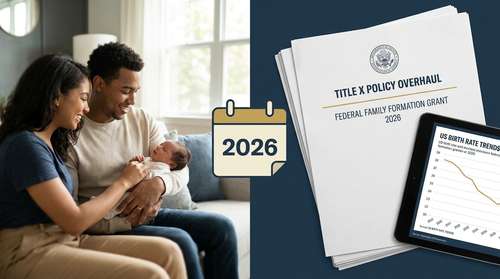
The landscape of reproductive healthcare in the United States is undergoing a dramatic transformation this week. Driven by the stark US birth rate decline 2026 data, the administration has introduced a sweeping overhaul of the nation's premier family planning program. With newly proposed family formation grants and the much-discussed federal baby bonus 2026, these shifts represent a fundamental reimagining of federal maternal care. Here is what families need to know about the latest maternal health news and how these evolving policies will impact millions of Americans.
Understanding the Title X Policy Changes
For more than five decades, the Title X family planning program has served as the primary federal safety net for millions of low-income and uninsured Americans seeking reproductive services. However, the latest Department of Health and Human Services (HHS) guidance for the fiscal year 2027 funding cycle signals a profound departure from the program's traditional framework.
Recent Title X policy changes have shifted the focus away from pharmaceutical contraception and the prevention of unintended pregnancies. Instead, the newly released 67-page Notice of Funding Opportunity prioritizes natural family planning, fertility awareness, and the treatment of reproductive health conditions like endometriosis and polycystic ovary syndrome (PCOS). Providers seeking funding are now expected to integrate evidence-based practices that promote fertility and family formation without relying on unnecessary medicalization.
The Financial Reality for Clinics
The abrupt nature of these policy shifts has left many safety-net clinics in a precarious position. Historically, providers had several months to prepare for changes in federal guidelines. This year, however, clinics were initially given just one week in March to respond to the changing framework. Furthermore, the administration plans to cap the available Title X funding at roughly $257 million for the upcoming cycle—a noticeable drop from the $286 million budget that had remained steady for nearly a decade. This reduction forces many longstanding clinics to overhaul their service models to maintain their federal grants.
Addressing the US Birth Rate Decline 2026
The driving force behind this unprecedented policy shift is the latest demographic data. According to the Centers for Disease Control and Prevention (CDC), the country recorded roughly 3.6 million births in 2025, marking a 1% decline from the previous year. Furthermore, the general fertility rate fell to a record low of 53.1 births per 1,000 women aged 15 to 44—a 23% plunge since 2007.
In response to the US birth rate decline 2026, federal officials have publicly called for a new baby boom. To reverse the downward demographic trend, the administration has begun soliciting proposals from policy groups to develop concrete fertility support incentives. Policymakers argue that shifting federal funding toward conception and healthy pregnancies will help counter the aging population curve while giving prospective parents the financial backing they need to grow their families.
How the Federal Baby Bonus 2026 Works
At the center of these pronatalist efforts is the widely debated federal baby bonus 2026. As a direct cash incentive meant to alleviate the initial economic shock of childbirth, the proposed $5,000 one-time payment would be distributed to American mothers following delivery.
Raising a child is an expensive endeavor, with recent estimates suggesting the cost of raising a child through age 18 hovers around $300,000. While a single $5,000 payment will not single-handedly neutralize the astronomical costs of modern child-rearing, proponents argue that robust family formation grants provide vital stability during the vulnerable newborn phase. For low-income mothers, research indicates that targeted financial injections during the month of birth can drastically reduce newborn poverty rates—potentially cutting them from 26 percent down to under 3 percent. By combining the baby bonus with potential expansions to the child tax credit, policymakers hope to empower couples who want children but feel financially insecure.
Will Fertility Support Incentives Actually Help?
Demographers and economists remain divided on the long-term effectiveness of direct cash payments. Some analysts argue that a baby bonus delivers immediate, targeted poverty reduction for families with newborns. However, other researchers contend that delayed childbearing is tied to broader societal shifts, such as the pursuit of stable employment, student debt, and the high cost of housing. Experts note that while the bonus is a helpful financial buffer, it may not be enough to drastically alter nationwide fertility trends.
The Impact on Reproductive Health Care Access
While the focus on fertility support is welcomed by some family advocates, the restructuring of Title X has generated intense concern among medical professionals regarding reproductive health care access. Historically, Title X served over 5 million patients at its peak, providing crucial access to birth control, wellness exams, and cancer screenings. Six in ten Title X clients have reported the program as their sole source of health care in a given year.
Public health experts warn that stripping the explicit goal of preventing unintended pregnancies from the grant criteria could severely limit options for low-income patients. Critics argue that shifting funds away from clinics that provide comprehensive contraceptive options toward organizations focused exclusively on fertility awareness could disrupt care for millions who rely on the federal safety net.
As the deadline for the 2027 funding applications approaches, clinics nationwide are scrambling to interpret the new guidance. Whether the federal baby bonus 2026 and the accompanying policy shifts will spark the desired baby boom remains to be seen. For now, families and healthcare providers must navigate a rapidly changing landscape where the government's approach to reproductive health has fundamentally shifted.