A sweeping new federal directive has just reshaped the landscape of psychiatric care in the United States. Signed in the Oval Office on April 18, 2026, the "Accelerating Medical Treatments for Serious Mental Illness" executive order directly addresses the nation's soaring suicide rates by fast-tracking psychedelic therapy for PTSD and depression. Flanked by federal health officials, veteran advocates, and prominent voices like podcaster Joe Rogan, President Donald Trump initiated a procedural overhaul that aims to bring highly restricted substances out of regulatory limbo and into clinical settings.
A Historic Shift in Veteran Mental Health Care
For decades, military personnel returning home with severe trauma have been funneled into a conventional psychiatric system that relies heavily on daily antidepressants and standard talk therapy. Unfortunately, these methods frequently fall short for complex, combat-related trauma. The human cost of this treatment gap is devastating. Since the September 11 attacks, the United States has lost over 21 times more veteran lives to suicide than on the battlefield, a statistic that underscores the critical need to rethink veteran mental health by advancing psychedelic therapy for PTSD.
This latest executive action marks a radical departure from the cautious, tightly restricted drug policies of the past fifty years. By officially prioritizing breakthrough mental health treatments—including compounds like psilocybin, LSD, and MDMA—the federal government is validating decades of quiet advocacy by researchers and patients who have argued that these medicines deserve expedited scientific evaluation.
$50 Million Ibogaine Research Funding Leads the Charge
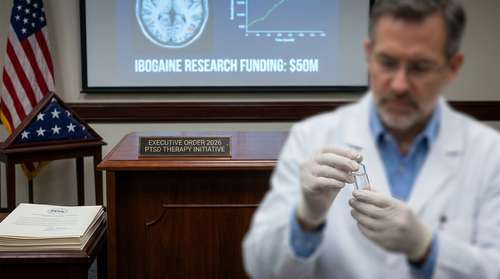
One of the most immediate and consequential pillars of the directive is a substantial $50 million ibogaine research funding commitment. Derived from the root bark of the African Tabernanthe iboga shrub, ibogaine is a powerful, naturally occurring psychoactive alkaloid. While the Drug Enforcement Administration currently classifies it alongside heroin as a Schedule I substance with no accepted medical use, clinical data paints a distinctly different picture.
Recent scientific inquiries suggest ibogaine possesses a unique ability to interrupt opioid addiction and repair traumatic brain injuries (TBI). A landmark 2024 Stanford University study involving 30 Special Operations veterans found that a single supervised ibogaine session safely led to drastic, long-lasting improvements in functional outcomes, easing anxiety and depression.
By matching a similar $50 million initiative previously passed by the Texas Legislature, the federal government aims to launch large-scale, rigorous clinical trials. These upcoming studies are essential, as researchers must develop standardized protocols to mitigate ibogaine's known cardiovascular risks, including potentially fatal heart rhythm disturbances.
Expanding Access Under Right to Try Laws 2026
The bureaucratic hurdles blocking patient access to experimental drugs have long frustrated the veteran community. Faced with a lack of domestic options, many desperate individuals have traveled to unregulated clinics in Mexico or the Caribbean, sometimes receiving treatment without proper cardiac monitoring. The White House aims to curb this medical tourism by expanding supervised access under the right to try laws 2026 framework.
The order directs the FDA and DEA to establish clear, legal pathways for desperately ill patients to access investigational psychedelic compounds outside of traditional clinical trials. By granting necessary handling authorizations to treating physicians and researchers, the administration hopes to provide immediate relief to patients whose conditions have proven entirely resistant to conventional care.
Streamlining MDMA Therapy FDA Reviews
Regulatory red tape is often the death knell for experimental medications. To prevent promising therapeutics from stalling, the directive introduces specialized administrative fast-tracks. Most notably, it directs the FDA to issue "Commissioner's National Priority Vouchers" to specific psychedelic medicines that already carry a Breakthrough Therapy designation.
This procedural maneuver is designed to drastically compress the standard 10-to-12-month New Drug Application (NDA) review timeline down to a mere one to two months, utilizing a highly collaborative, "tumor board-style" evaluation process. Consequently, the pathway for MDMA therapy FDA approval could move forward at an unprecedented speed. Furthermore, the order instructs the Department of Justice to initiate rescheduling reviews immediately upon the successful completion of Phase 3 trials, ensuring that drugs can hit the market rapidly once approved.
Unprecedented Interagency Coordination
Siloed data has historically slowed down medical innovation. To combat this, the executive order mandates that the Department of Health and Human Services (HHS), the FDA, and the Department of Veterans Affairs (VA) sign new data-sharing memoranda. Pooling clinical trial data and real-world evidence from across the executive branch will give regulators a comprehensive look at both the safety and efficacy of these potent compounds.
The Future of PTSD Treatment Innovation
While this directive does not unilaterally legalize psychedelic compounds or guarantee insurance coverage, it fundamentally shifts the federal government's posture from prohibition to proactive investigation. Veterans' organizations, including the Veterans of Foreign Wars (VFW), have widely praised the move as a long-overdue victory against bureaucratic inertia.
As clinical trials spin up and regulatory barriers fall, the next year will be critical for PTSD treatment innovation. If early studies translate successfully into large-scale clinical practice, this weekend's executive action may be remembered as the moment the United States finally turned the tide on its mental health crisis.