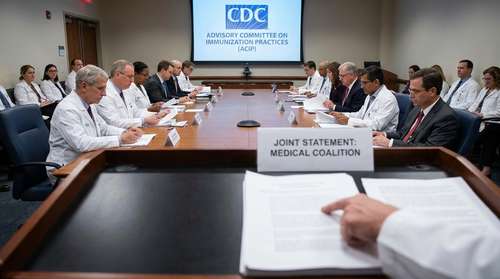
In a sweeping public declaration issued over the weekend of April 18, 2026, the ongoing clash between federal health agencies and the medical community reached a boiling point. Building on clinical guidance published just days prior on April 15, a powerful coalition of over 130 medical and public health organizations escalated their response to the controversial CDC childhood vaccine schedule 2026. Spearheaded by the American Academy of Pediatrics (AAP) and the American Medical Association (AMA), the groups issued an urgent warning to parents, urging them to ignore recent federal reductions and adhere to traditional immunization guidelines to protect against preventable diseases.
The rift stems from federal directives initiated early this year that reduced the number of universally recommended childhood vaccines from 17 to 11. As pediatricians navigate these sweeping updates this spring, this latest weekend summit highlights the profound divide between federal policy and front-line pediatric care. For families trying to make sense of the biggest childhood health news 2026 has to offer, understanding the difference between historical standard recommendations and these new federal categories is critical.
Understanding the CDC Childhood Vaccine Schedule 2026 Overhaul
The controversy began earlier this year when the Centers for Disease Control and Prevention (CDC) formally accepted a presidential directive to evaluate and overhaul pediatric immunizations. Bypassing traditional advisory committee protocols—an administrative move often criticized amid the broader ACIP charter changes 2026—federal officials shifted several prominent immunizations out of the universal "routine" category.
Under the new pediatric immunization guidelines, core protections like the measles, mumps, and rubella (MMR) vaccine, polio, and DTaP remain universally recommended. However, protections against Hepatitis A, Hepatitis B, Rotavirus, Influenza, COVID-19, and Meningococcal disease have been moved to a "shared clinical decision-making" (SCDM) or high-risk only tier. The CDC stated that this more focused schedule aligns with select international practices and aims to rebuild public trust by recommending fewer standard shots for healthy children.
The American Academy of Pediatrics Vaccine Statement
The medical community's response has been swift and unforgiving. In their latest unified push this weekend, doctors reaffirmed that the epidemiological evidence supporting all 17 traditional vaccines remains rock-solid. The official American Academy of Pediatrics vaccine statement labels the CDC's universal recommendation removals as "dangerous and unnecessary".
According to Dr. Andrew D. Racine, President of the AAP, the federal pivot is an "ill-considered decision" that "will sow further chaos and confusion" among families. Medical leaders are pointing to historical successes that are now at risk. For example, Hepatitis B infections in infants dropped by 99% after a universal birth dose was introduced in 1991, and statistics show that nearly 89% of pediatric influenza deaths last season occurred in children who were not fully vaccinated. To combat the perceived risks of the federal overhaul, the AAP has released its own competing 2026 immunization schedule—endorsed by groups representing over one million healthcare professionals—which firmly maintains the robust traditional vaccine roster.
The Risks of "Shared Clinical Decision Making for Parents"
At the heart of the pediatric backlash is the new reliance on shared clinical decision making for parents. Historically, this medical classification was reserved for treatments where benefits did not clearly outweigh risks, or for highly individualized patient scenarios. Doctors argue that applying it to proven preventative care fundamentally diminishes their perceived importance.
By applying this classification to standard preventative care, pediatricians warn that vaccination rates will inevitably drop. For instance, before this policy shift, the universally recommended rotavirus vaccine routinely prevented an estimated 40,000 to 50,000 infant hospitalizations annually. Furthermore, doctors note that while SCDM requires a conversation between the provider and family, it does not require a special appointment. Standard practices like reviewing Vaccine Information Statements (VIS) remain in place, but health experts worry that framing essential protections as merely optional discussions will leave millions of children vulnerable to severe outbreaks.
Mandatory vs Recommended Vaccines for Kids: Navigating the Confusion
With conflicting schedules now in circulation, the debate over mandatory vs recommended vaccines for kids has never been more perplexing for parents. Families are left wondering which shots are truly necessary for school entry, daycares, and general health and safety.
Despite the federal reclassifications, doctors emphasize that these administrative changes do not alter the scientific safety or efficacy of the vaccines. Pediatricians across the country are continuing to strongly recommend the full spectrum of immunizations during routine wellness visits. The AAP is urging parents to look past the political noise and rely on the decades of clinical data that prove these immunizations keep communities safe.
Will Insurance Still Cover These Vaccines?
One major area of relief for parents in this ongoing saga is financial access. Federal health officials from both the CDC and CMS have confirmed that all vaccines on the updated schedule—regardless of whether they are universally recommended or fall under shared clinical decision-making—will continue to be fully covered by insurance.
If you have an Affordable Care Act-compliant health plan, or if your child relies on Medicaid or the federal Vaccines for Children (VFC) program, you will not face co-pays or deductibles for these essential pediatric shots. The AAP has also confirmed updated coding procedures to ensure pediatricians are properly reimbursed for counseling parents through these new SCDM conversations.
As the debate surrounding the 2026 pediatric schedules rages on, the unified message from the nation's top pediatricians this weekend remains clear: trust the science, stick to the comprehensive schedule, and protect your children against preventable diseases.