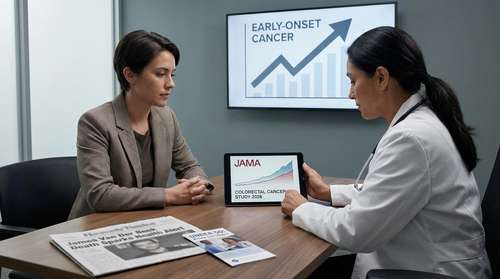
A devastating week for Hollywood has coincided with a grim milestone in medical research, creating a perfect storm of awareness around a silent killer. Just two days after the death of actor James Van Der Beek at age 48, a landmark study published today in the Journal of the American Medical Association (JAMA) confirms a terrifying shift: colorectal cancer under 50 is now the leading cause of cancer death for young adults in the United States. The Dawson’s Creek star’s passing, coupled with these new findings, has sparked an urgent conversation about early onset colon cancer symptoms and the critical need for younger screening protocols.
The JAMA Colorectal Cancer Study 2026: A 'Structural Shift'
The new research, released on February 13, 2026, paints a stark picture of generational health. While overall cancer mortality for adults under 50 has plummeted by 44% since 1990—thanks to strides in treating lung, breast, and brain cancers—colorectal cancer is moving in the opposite direction. According to the study, mortality rates for young-onset colorectal cancer have climbed by approximately 1.1% annually since 2005.
"This is not a statistical fluctuation; it is a structural shift," researchers noted in the JAMA report. For decades, colorectal cancer trailed behind other malignancies. Now, it has overtaken them to become the number one cancer killer in this age group. The data reveals that while older generations are seeing fewer cases due to routine screening, adults born after 1990 face double the risk of colon cancer and quadruple the risk of rectal cancer compared to those born in 1950.
James Van Der Beek: A Tragedy of 'Hidden' Symptoms
The statistics have a human face in James Van Der Beek, whose death on February 11 has shaken fans and health advocates alike. Known for his athleticism and commitment to wellness—routinely sharing his cold plunge and exercise routines—Van Der Beek represented the picture of health. Yet, as he revealed in interviews prior to his passing, he was diagnosed with Stage 3 colorectal cancer in late 2024 after dismissing subtle warning signs.
Van Der Beek admitted to ignoring changes in his bowel movements, attributing them to his diet. "I thought maybe I needed to stop coffee, or maybe not put cream in it," he told Healthline in 2025. "I was in amazing cardiovascular shape... and I had stage 3 cancer and had no idea." His story illustrates a dangerous misconception: that cancer only strikes the unhealthy or the elderly. By the time symptoms like his become undeniable, the disease has often progressed to an advanced stage, which is the case for three out of four young patients.
Missed Warning Signs: What Young Adults Ignore
The tragedy of James Van Der Beek's death health battle highlights the subtle nature of early onset colon cancer symptoms. Unlike the dramatic signs often depicted in media, early indicators can be easily explained away as hemorrhoids, IBS, or dietary intolerance. The American Cancer Society and recent studies have identified four key red flags that young adults frequently overlook:
- Rectal Bleeding: Often mistaken for hemorrhoids, especially in healthy young people.
- Persistent Abdominal Pain: Cramping or discomfort that doesn't resolve with standard treatments.
- Changes in Bowel Habits: Narrow stools, diarrhea, or constipation lasting more than a few days (the symptom Van Der Beek experienced).
- Unexplained Weight Loss or Fatigue: Often linked to iron-deficiency anemia from slow, invisible blood loss.
The 'Healthy Patient' Paradox
Doctors warn that the "healthy patient" profile can actually delay diagnosis. Young adults with no family history often do not advocate for themselves, and clinicians may hesitate to order invasive testing for a 30- or 40-year-old. The new JAMA data suggests that waiting for severe symptoms is a fatal error. If you experience any persistent change in digestion, regardless of your fitness level, experts urge you to push for answers.
Young Adult Cancer Prevention: Screening at 45
In light of the JAMA colorectal cancer study 2026, health officials are doubling down on the colonoscopy age 45 guidelines established by the USPSTF. While the screening age was lowered from 50 to 45 several years ago, adherence remains dangerously low in the 45–49 demographic. Van Der Beek himself admitted he was unaware of the lowered guideline until his diagnosis.
"45 is the new 50," states Dr. Vikram Reddy, a colorectal surgeon. "Lives will be saved by preventing cancers and catching them at an earlier stage." For those with a family history of polyps or cancer, screening should begin even earlier—typically 10 years before the age at which the youngest family member was diagnosed.
Family Health Screening Alerts and Next Steps
The convergence of the JAMA study and a high-profile celebrity death serves as a grim family health screening alert. The medical community is calling for a proactive approach: young parents and professionals must know their family history and recognize that lifestyle alone is not total protection. While diet, exercise, and avoiding processed meats reduce risk, they do not eliminate it.
Van Der Beek’s final message to the public was one of advocacy: "I really want to impress upon people that you don't need symptoms to get screened." Honoring his legacy means taking action—scheduling that colonoscopy, discussing "embarrassing" symptoms with a doctor, and recognizing that in the fight against the under-50 cancer crisis, early detection is the only guaranteed cure.