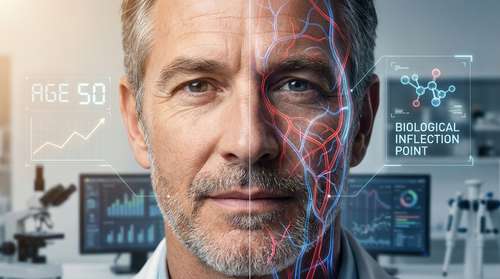
The human experience of growing older has long been viewed as a slow, steady decline, but new scientific coverage released on March 19, 2026, shatters that long-held assumption. According to groundbreaking tissue-specific aging research spearheaded by the Chinese Academy of Sciences, our bodies do not degrade on a linear trajectory. Instead, researchers have identified a dramatic biological age inflection point characterized by a sudden aging acceleration at 50. This midlife molecular upheaval fundamentally changes how organs function, shifting the medical understanding of growing older from a gradual fade to a series of steep physiological cliffs.
The Science Behind the Biological Age Inflection Point
For decades, medical professionals assumed that cellular wear and tear occurred uniformly. However, the latest comprehensive reviews of human proteome profiles reveal that our internal systems operate on highly individualized timelines. By tracking over 12,700 distinct proteins across 13 different tissue types in humans spanning five decades of life, scientists constructed the most detailed molecular map of human degradation to date.
The data points to a distinct biological age inflection point striking right at the half-century mark. Between the ages of 45 and 55, the human body undergoes a 'molecular cascade storm'. During this narrow window, the expression of 48 disease-associated proteins surges exponentially. These proteins are directly linked to cardiovascular conditions, tissue fibrosis, and fatty liver disease. Rather than a slow accumulation of damage, this aging acceleration at 50 represents a sudden and aggressive remodeling of the body's entire protein landscape.
Decoding Proteomic Age Clocks and Vascular Decline
To accurately track these sudden shifts, researchers developed advanced proteomic age clocks. Unlike chronological age, which merely counts the years you have been alive, these AI-driven biological trackers measure the precise degradation of individual organs based on their unique protein signatures. The clocks revealed a startling truth: not all tissues age simultaneously.
Vascular Aging Signs: The Aorta as Ground Zero
Among the most vulnerable systems is the cardiovascular network. The Chinese Academy of Sciences' findings confirm that the aorta—the body's largest artery—is one of the first major organs to drift from its youthful baseline. Clear vascular aging signs begin to manifest rapidly as the cardiovascular system takes the brunt of this midlife decline.
The aorta acts as a systemic 'senohub,' meaning its degradation doesn't happen in isolation. When the arteries age, they begin pumping out 'senoproteins,' such as GAS6, which act as biological aging instructions delivered through the bloodstream to distant organs. This indicates that vascular decline actually drives whole-body aging, effectively acting as the remote control for systemic physical deterioration.
Translating Tissue-Specific Aging Research into Treatment
Understanding that the circulatory system orchestrates this midlife crash is revolutionizing how geriatric specialists approach chronic disease. Tissue-specific aging research provides a localized roadmap of physical decline, allowing doctors to predict which organs will fail before clinical symptoms even appear.
Because the proteomic remodeling is so heavily concentrated in the cardiovascular system and the adrenal glands, therapies targeting these specific areas could theoretically halt the systemic spread of cellular senescence. If scientists can neutralize the inflammatory proteins released by an aging aorta, they may be able to protect secondary organs—like the spleen and pancreas—from experiencing their own rapid, sustained deterioration.
How to Slow Aging After 50: Precision Longevity Medicine
With the exact timing and mechanisms of this midlife cliff now mapped, the medical community is shifting focus toward actionable interventions. The most pressing question for the public is how to slow aging after 50 now that this critical biological transition window has been identified.
The answer lies in precision longevity medicine. This emerging field uses individual proteomic profiling to develop highly customized interventions. While lifestyle factors like maintaining cardiovascular fitness, managing lipid levels, and reducing systemic inflammation remain fundamental, the future of treatment is molecular. Pharmacological interventions are currently being explored to restore protein balance—known as proteostasis—specifically within the blood vessels before the age 50 inflection point hits.
For individuals approaching their late forties, monitoring vascular health is no longer just about preventing heart attacks; it is the primary defense against whole-body aging. By prioritizing interventions that protect arterial flexibility and reduce endothelial inflammation, you can potentially blunt the impact of the molecular cascade storm and extend your years of vibrant, functional health well beyond the half-century mark.