For decades, fitness culture has bombarded us with the idea that building muscle requires military-style discipline, expensive gym memberships, and dizzyingly complex workout periodization. That era is officially over. In March 2026, the American College of Sports Medicine released its first major update to weightlifting recommendations in 17 years. The highly anticipated ACSM resistance training guidelines 2026 deliver a liberating message for the average adult: consistency beats complexity, and the elusive "perfect workout" is a myth.
Published in Medicine & Science in Sports & Exercise, the landmark Position Stand synthesizes data from 137 systematic reviews involving more than 30,000 participants. It represents the most comprehensive overview of strength literature ever assembled. The previous guidelines, released in 2009, were frequently criticized for being too rigid and rule-heavy. Instead of relying purely on expert consensus, researchers utilized the rigorous GRADE framework to evaluate exactly what drives long-term results. Their findings fundamentally shift how we approach exercise, emphasizing that bridging the gap from doing nothing to doing something yields the most profound physical transformations.
The Core Message: Consistency Over Complexity
Since the last guidelines were published, fitness research has experienced a massive boom regarding the role of muscle in aging and metabolic health. Yet, the takeaways from the past 17 years of data point toward simplification rather than intricate programming. The updated ACSM resistance training guidelines 2026 explicitly state that strict rules regarding sets, reps, and precise rest periods often create unnecessary psychological barriers that deter people from starting in the first place.
Dr. Stuart M. Phillips, a leading author on the Position Stand and professor in the Department of Kinesiology at McMaster University, summarized the paradigm shift perfectly. He noted that the best routine isn't the one meticulously crafted by a fitness influencer; it is the one you will actually stick with week after week. Targeting all major muscle groups at least twice weekly matters infinitely more than tracking highly specific variables like time-under-tension or complex periodization models. When friction is lowered, adherence naturally rises.
Redefining Exercise: Home Resistance Training Benefits
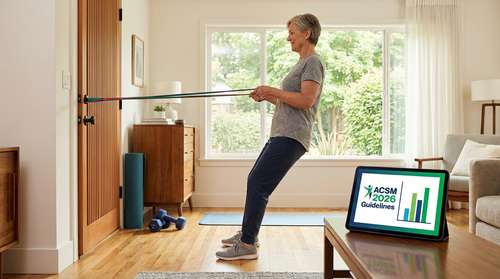
One of the most significant revelations from the extensive data review is that traditional gym environments are entirely optional for the average healthy adult. The research confirms that home resistance training benefits are remarkably potent. Whether you are lifting heavy barbells in a commercial facility, stretching elastic bands, or utilizing your own body weight in the living room, your muscles respond similarly to the mechanical tension.
This is outstanding news for individuals who feel intimidated by the traditional iron-era gym culture but are focused on aging well. Engaging in regular muscle preservation exercises without the friction of a daily commute makes it vastly easier to maintain a lifelong habit. Furthermore, researchers completely debunked the long-held belief that everyday adults must train to the point of momentary muscle failure. Stopping a few repetitions short of complete exhaustion still delivers exceptional improvements in muscle size and strength, significantly reducing the risk of joint injury and severe post-workout soreness.
Customizing Your Routine for Specific Goals
While the overall theme is widespread accessibility, the 2026 document does offer specific, evidence-backed parameters for those looking to optimize their efforts toward a particular outcome. If your primary goal is maximizing raw strength, the science suggests lifting heavier loads—approximately 80 percent of your one-repetition maximum—for two to three sets per exercise.
Conversely, if you want to increase muscle size (hypertrophy), overall volume is the primary driving factor. Accumulating around 10 working sets per muscle group per week will yield optimal growth, with a slight emphasis on the lowering (eccentric) phase of the movement. For those interested in power and explosive athleticism, using lighter to moderate weights (30 to 70 percent of your maximum) and moving them quickly is the recommended path. Naturally, athletes with specific competitive ambitions will still require highly individualized, sport-specific programming.
A Milestone in Evidence-Based Fitness News
The health and wellness industry is notorious for recycling fads and overcomplicating basic physiology to sell digital programs. This latest update effectively cuts through the commercial noise. As a critical piece of evidence-based fitness news, the 2026 stance clarifies that beginners do not need completely different or wildly unique training regimens compared to more seasoned lifters. The fundamental mechanisms of muscle adaptation remain the same regardless of your experience level.
By moving away from "one-size-fits-all" mandates, the American College of Sports Medicine is actively encouraging personalization based on personal enjoyment and safety. This philosophical pivot recognizes a fundamental truth: if a training program is too mentally or physically demanding to maintain, it inherently loses its effectiveness. A realistic, sustainable routine will always outperform a supposedly optimal plan that you end up abandoning after just three weeks.
Designing Simple Workouts for Healthspan
The medical community increasingly views muscle tissue as an endocrine organ that plays a vital role in glucose management, disease prevention, and longevity. The ACSM resistance training guidelines 2026 cement weightlifting as an essential medical intervention, not merely a tool for bodybuilders. Embracing strength training for longevity means prioritizing your daily physical capacity over aesthetics.
If you have been hesitant to start lifting, the barrier to entry has never been lower. You can easily build simple workouts for healthspan by selecting a handful of fundamental functional movements—like bodyweight squats, modified push-ups, and resistance band rows—and performing them a couple of days a week. This straightforward approach directly supports physical function resistance training, enhancing practical abilities like walking speed, balance, and the capacity to stand up from a low chair effortlessly as you age.
The science has finally spoken definitively, stripping away the intimidation factor of strength development. You do not need the perfect gym, the perfect equipment, or the perfect program to build a stronger, healthier body. You just need to start, put in an honest effort, and keep showing up.