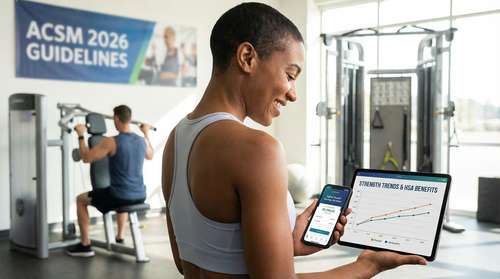
The intersection of science-backed exercise and financial wellness has reached a new milestone. The American College of Sports Medicine (ACSM) recently released its sweeping 2026 position stand on resistance exercise. This landmark update formally prioritizes what fitness circles are dubbing "strengthmaxxing"—a dedicated focus on progressive resistance training for its outsized impact on brain longevity and metabolic health. This scientific shift aligns perfectly with the evolving financial landscape, as recent policy and platform integrations now allow Americans to utilize pre-tax HSA and FSA funds for subscriptions, recovery tools, and home gym setups. If you want to optimize your physical health and your wallet simultaneously, understanding these ACSM 2026 fitness trends is your first step.
What Is 'Strengthmaxxing' and the ACSM 2026 Guidelines?
The ACSM's updated guidance marks the first major revision to resistance training guidelines in 17 years. Drawing on 137 systematic reviews that analyzed data from more than 30,000 participants, the message from researchers is refreshingly straightforward: any amount of strength training is significantly better than none. While optimal routines involve targeting major muscle groups at least twice a week, the priority has shifted from chasing "perfect" regimens to building consistency.
This philosophy forms the core of strengthmaxxing for longevity. Rather than obsessing over complex periodization schemes, the guidelines emphasize finding a routine you enjoy and sticking with it over the long haul. Whether utilizing barbells, resistance bands, or simple bodyweight exercises, regular muscle contraction combats age-related sarcopenia, preserves bone mineral density, and radically improves insulin sensitivity.
Resistance Training for Brain Health
Physical strength is only half the equation. Recent neuroscientific research emphasizes the critical role of resistance training for brain health. A comprehensive meta-analysis published in Frontiers in Aging Neuroscience evaluated 58 randomized controlled trials, finding that resistance training ranked highest among all exercise types for improving global cognition and inhibitory control.
Furthermore, data from the LISA1 aging trial indicates that heavy resistance training can actively slow the biological aging of the brain by up to 2.3 years. Lifting weights requires intense neurological engagement, which stimulates prefrontal functional connectivity and reduces chronic neuroinflammation. Every time you challenge your muscles to move an external load, you are essentially forcing your nervous system to adapt, reinforcing neural pathways and defending against cognitive decline.
Unlocking HSA Eligible Fitness Apps 2026 and Equipment
As the medical community increasingly recognizes exercise as preventative medicine, payment networks have rapidly evolved to match. Thanks to seamless integrations from health payment platforms like Truemed and Flex, consumers can now leverage pre-tax dollars for physical wellness. The process for securing HSA eligible fitness apps 2026—including popular platforms like BODi, Fitbod, and Jillian Michaels' The Fitness App—has become entirely friction-free.
By completing a brief online health questionnaire at checkout, users can obtain a Letter of Medical Necessity (LMN) if the exercise program helps treat or prevent a specific medical condition. This precise mechanism also opens the door for FSA fitness equipment reimbursement. Shoppers looking to invest in the best home gym gear 2026—ranging from intelligent resistance machines to traditional adjustable dumbbells and power racks—can effectively save 30% to 40% by using their pre-tax accounts.
The eligibility list has even expanded to include trending recovery modalities. High-end cold plunges, celebrated for their ability to lower inflammation and soothe delayed onset muscle soreness, are now accessible via these same pre-tax channels. By obtaining a provider's LMN for conditions like chronic joint pain or arthritis, you can use your HSA card directly at checkout for premium ice bath systems.
Maximizing Medicare Fitness Benefits 2026
The preventative healthcare push extends to the older demographic—the exact population that arguably benefits most from structured resistance training. While Original Medicare (Parts A and B) still does not cover gym memberships out-of-pocket, the coverage landscape for private plans has transformed dramatically. As of 2026, an impressive 93% of individual-enrollment Medicare Advantage plans offer a designated fitness benefit.
These expansive Medicare fitness benefits 2026 include widespread access to established programs like SilverSneakers, Renew Active, and Silver&Fit. Beneficiaries can access local gyms, participate in specialized senior-focused strength classes, and utilize home fitness resource libraries at no additional cost beyond their standard plan premiums. For individuals looking to implement the ACSM's strength-building protocols, tapping into these Medicare perks is the most cost-effective way to build functional muscle and safeguard cognitive health into their later years.
Whether you are outfitting a home gym with tax-advantaged dollars or leveraging a free membership through your health plan, the barriers to entry for resistance exercise have never been lower. The science is definitive: picking up a weight is a guaranteed investment in your brain, your metabolism, and your future longevity.