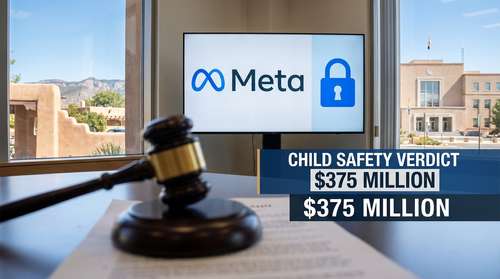
A Santa Fe jury has delivered a historic blow to Big Tech, finding social media conglomerate Meta liable for endangering youth and willfully ignoring severe psychological harms. In a highly anticipated Meta child safety verdict announced on Tuesday, March 24, 2026, jurors concluded that the parent company of Instagram and Facebook prioritized user engagement and corporate profits over the well-being of its youngest consumers. The ruling ordered the tech giant to pay a $375 million penalty, setting a profound new precedent for corporate accountability in the digital age.
Landmark New Mexico Meta Lawsuit Concludes
After a grueling seven-week trial, the New Mexico Meta lawsuit culminated in a decisive victory for state prosecutors. Initiated by Attorney General Raúl Torrez in 2023, the legal action argued that Meta deliberately misled the public about the inherent dangers of its platforms. Jurors ultimately found the company guilty of violating the state's Unfair Practices Act.
The jury determined that Meta engaged in unconscionable trade practices that unfairly exploited the vulnerabilities and inexperience of children. Although the state initially sought up to $2.2 billion in damages, the $375 million penalty represents the maximum allowable civil fine of $5,000 applied across tens of thousands of individual violations. State officials and child advocates are already celebrating the outcome as a monumental step forward.
"The jury's verdict is a historic victory for every child and family who has paid the price for Meta's choice to put profits over kids' safety," Attorney General Torrez stated following the decision. He emphasized that executives disregarded direct warnings from their own internal researchers and actively lied to the public.
The Core of the Meta Child Safety Verdict
Throughout the proceedings, prosecutors presented a massive volume of evidence, including testimony from around 40 witnesses such as whistleblowers, alongside confidential internal communications. This documentation revealed that leadership was largely aware of the severe harms their platforms facilitated but chose to conceal the scale of the crisis from parents and regulators.
Uncovering the Exploitation Risks
A crucial and deeply disturbing aspect of the trial focused on the proliferation of online predators. State investigators previously created decoy accounts posing as young teenagers to demonstrate how the platform's algorithmic recommendations actively directed adults toward content posted by minors. The resulting Meta exploitation ruling condemned the company for its lackluster structural safeguards.
Witnesses detailed how specific design choices enabled human trafficking and online solicitation. By failing to deploy adequate protective measures, the company allowed these networks to operate with relative impunity. Internal documents displayed during the trial highlighted that safety teams had routinely flagged these vulnerabilities. However, leadership allegedly ignored these warnings to avoid impacting user metrics. This disregard for user safety heavily influenced the final penalty calculations.
A Turning Point for Social Media and Child Mental Health
This verdict extends far beyond predatory behavior; it strikes at the very heart of the ongoing crisis surrounding social media and child mental health. The prosecution highlighted how the continuous scroll, aggressive notification systems, and hyper-curated feeds are deliberately engineered to create addictive feedback loops.
With youth anxiety and depression rates surging nationwide, the trial provided a sobering look into the latest pediatric mental health news. The jury agreed that Meta's intentional design elements exacerbated body image issues, self-harm content exposure, and severe depressive episodes among adolescents. The continuous exposure to unrealistic standards and cyberbullying creates a toxic environment that many children struggle to navigate.
Representatives for Meta have stated they plan to appeal the decision. A spokesperson maintained that the company works vigorously to keep people safe and that identifying bad actors remains a complex, industry-wide challenge. Despite these claims, the financial penalty sends a clear message that courts are no longer accepting technical difficulty as an excuse for consumer harm.
Protecting Children Online 2026: The Future of Digital Safety
This ruling represents merely the first wave in a massive legal reckoning. As of late March, California courts are deliberating similar lawsuits, and over 40 state attorneys general are pursuing independent actions against various tech giants. For those focused on protecting children online 2026 is shaping up to be a highly transformative year.
The demand for robust digital safety for families has never been louder. Parents, educators, and lawmakers are increasingly unified in their call for strict regulations. The most frequently proposed solutions include:
- Mandatory and effective age verification protocols.
- Algorithmic transparency and chronological feeds as default settings for minors.
- Stricter penalties for failing to remove predatory accounts swiftly.
- Enhanced parental controls that cannot be easily bypassed by tech-savvy teens.
The implications of this ruling will likely ripple across the entire tech sector. Competing platforms are undoubtedly monitoring the fallout, recognizing that the legal shield they once relied upon is rapidly deteriorating. A second phase of the New Mexico trial, scheduled to begin in May, will involve a judge deciding whether Meta must implement specific, court-mandated platform changes. If granted, these operational shifts could finally force the systemic overhaul that safety advocates have demanded for years.