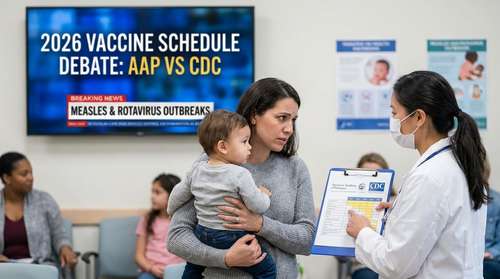
Pediatric emergency rooms across the country are currently grappling with a severe rotavirus surge in children, compounding the historically devastating measles outbreak 2026 has already brought to states like South Carolina and Utah. But for families trying to protect their infants and toddlers, fending off highly contagious viruses is only half the battle. Parents are increasingly caught in a dizzying medical tug-of-war over the 2026 childhood vaccine schedule.
Following the Centers for Disease Control and Prevention's (CDC) controversial January decision to reduce universally recommended childhood vaccines from 17 to 11, the American Academy of Pediatrics (AAP) drew a hard line. By explicitly refusing to endorse the federal government's downsized list and issuing its own comprehensive 18-disease schedule, the resulting AAP vs CDC vaccines conflict has left American families navigating a maze of conflicting pediatric advice.
The Great Divide: AAP vs CDC Vaccines
For more than three decades, the AAP and CDC worked in lockstep to provide unified pediatric immunization guidelines. That long-standing partnership fractured completely earlier this year. The CDC unilaterally moved critical immunizations against rotavirus, influenza, and hepatitis A into specialized, optional categories. In a swift, unprecedented rebuke, the AAP released its independent 2026 schedule, backed by a dozen major medical organizations, urging doctors to maintain traditional, evidence-based immunization standards.
This institutional split stems directly from recent RFK Jr health policy updates. Under HHS Secretary Robert F. Kennedy Jr., the federal vaccine framework was overhauled to align with alternative international schedules. This sweeping move bypassed the traditional scientific review process by the CDC's Advisory Committee on Immunization Practices (ACIP), which saw its members dismissed and reconstituted. Consequently, primary care physicians and parents now face two distinctly different roadmaps for childhood healthcare, sparking a fierce debate in clinics nationwide.
Measles Outbreak 2026 and the Rotavirus Surge in Children
The consequences of this policy friction are playing out in real-time. Over the last 48 hours, infectious disease experts and the CDC have warned of unexpectedly high levels of rotavirus spreading across the United States. Dehydration from this severe intestinal infection is sending infants to the hospital at alarming rates, a spike researchers directly attribute to declining vaccination numbers late into this season. Prior to routine vaccination, rotavirus caused up to 70,000 pediatric hospitalizations annually—a terrifying metric health officials fear could return.
Simultaneously, the measles outbreak 2026 has reached staggering proportions, threatening the nation's 25-year measles elimination status. South Carolina remains the epicenter with nearly 1,000 confirmed cases, while Utah health officials reported this week that their local outbreak has topped 600 infections. Because measles is one of the most contagious airborne viruses on the planet, falling community immunity thresholds have allowed the disease to easily bypass isolated clusters. The vast majority of these hospitalizations involve unvaccinated individuals, highlighting the immediate physical risks of shifting public health messaging.
The Reality of Shared Clinical Decision Making
A major point of friction for families is the CDC's new categorization of several routine shots under the umbrella of shared clinical decision making. Instead of universally recommending the rotavirus or influenza vaccines for all infants, the federal government now suggests these should only be administered after a specific, individualized consultation between parents and healthcare providers.
While this sounds empowering in theory, pediatricians argue it creates dangerous logistical hurdles. In practice, shared clinical decision making shifts the heavy burden onto families to proactively request vaccines that used to be standard protocol. It also introduces confusion over insurance coverage and slows down already rushed clinical visits, directly contributing to the dangerous drop in immunization rates we are witnessing this week. Many local pharmacies, which have become vital vaccination hubs, are simply unequipped to facilitate these prolonged clinical consultations.
The Role of Health Insurance in the Vaccine Debate
One of the most pressing questions for parents is whether their insurance will cover vaccines that the CDC no longer universally recommends. Fortunately, America's Health Insurance Plans (AHIP) has indicated that companies will continue to cover all vaccines previously recommended through 2026, largely because preventive vaccination makes clear economic sense by avoiding costly hospitalizations. However, pediatricians warn that as federal policies further diverge from the AAP's clinical standards, out-of-pocket costs could eventually become a harsh reality for families seeking comprehensive protection.
Navigating the New Pediatric Immunization Guidelines
With the landscape of pediatric immunization guidelines fundamentally altered, families are forced to act as their own medical advocates. If you are scheduling a wellness visit for your child, understanding the stark differences between the 2026 childhood vaccine schedule endorsed by the AAP and the truncated federal version is critical.
Medical professionals strongly advise maintaining an open, proactive dialogue with your pediatrician. The vast majority of pediatric clinics continue to follow the AAP's robust recommendations to ensure maximum coverage against the full spectrum of childhood illnesses. By staying informed about the ongoing federal policy shifts and the very real disease outbreaks in your local community, you can cut through the political noise and make the safest choices for your child's health.