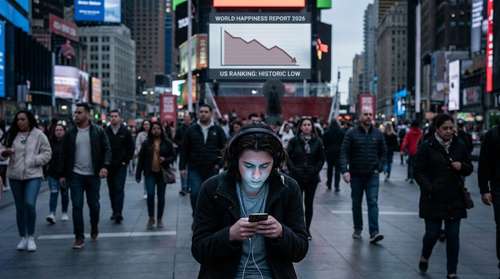
On this year's International Day of Happiness, the findings of the latest global wellbeing data have sent shockwaves through public health communities. The World Happiness Report 2026, released today, reveals that the United States has tumbled to 23rd place. While older generations of Americans remain relatively satisfied with their lives, the nation's overall standing has been dragged down by a severe and growing youth mental health crisis. Researchers are pointing to a stark, singular culprit: the pervasive influence of visual, algorithm-driven social media platforms.
The US Happiness Ranking 2026: Behind the Historic Drop
The annual report, powered by comprehensive data from the Gallup World Poll and analyzed by leading global wellbeing scientists, evaluates the life satisfaction of citizens across more than 140 countries. Historically, the United States maintained a comfortable position within the top 20. However, the US happiness ranking 2026 confirms a troubling downward trajectory that has been accelerating over the past few years.
While nations like Finland continue their dominance at the number one spot for the ninth consecutive year, and countries like Costa Rica surge to fourth place, the US is moving in the opposite direction. The data indicates that this drop is not distributed evenly across the population. If the rankings were based solely on Americans over the age of 60, the country would still sit comfortably in the top 10. Instead, the unprecedented fall to 23rd place is entirely driven by plummeting life evaluations among Americans under the age of 25.
This generational divide is particularly acute in English-speaking nations. Similar dramatic drops in youth wellbeing were observed in Canada, Australia, and New Zealand, suggesting a shared cultural or technological variable is heavily influencing young minds in these regions.
A Deepening Youth Mental Health Crisis
To understand the nation's declining happiness, public health officials are looking closely at Gen Z mental health statistics, which paint a grim picture of the current landscape. Young adults and teenagers are reporting unprecedented levels of anxiety, psychological distress, and isolation.
For the first time in modern history, the traditional trajectory of happiness—where youth is historically a period of high life satisfaction—has completely inverted in North America. Today, young people are among the least happy demographics in the country. The youth mental health crisis has escalated to a point where researchers evaluate the psychological state of many American adolescents as being equivalent to a mid-life crisis.
The data reveals that young people today feel fundamentally disconnected from their communities and lack a sense of purpose that previous generations possessed at the same age. Economic pressures play a role, but researchers note that these factors alone cannot explain the sheer magnitude of the decline, nor why it is localized so heavily in specific Western nations while youth happiness actually rises in other parts of the world.
Social Media and Depression: The Algorithmic Toll
The World Happiness Report 2026 dedicates significant analysis to the relationship between social media and depression. With contributions from prominent psychologists like Jonathan Haidt, author of The Anxious Generation, generational experts like Jean Twenge, and behavioral scientists, the findings draw a direct line between the mental health plunge and the daily consumption of algorithm-driven content.
Heavy use of visual, infinite-scroll platforms is uniquely damaging to adolescent development. The report notes that young people who limit their social media use to less than one hour a day report the highest levels of wellbeing, outperforming even those who do not use social media at all. However, adolescents are currently spending an average of 2.5 hours a day on these platforms. This constant exposure to algorithmic feeds correlates heavily with a drop in self-esteem and life satisfaction, particularly among teenage girls.
Battling the Loneliness Epidemic 2026
What emerges from the data is a paradox of modern connectivity: the most digitally connected generation in human history is suffering from the loneliness epidemic 2026. Visual social media platforms often replace rich, in-person interactions with shallow, performative digital exchanges. The resulting isolation strips young people of the social support networks and real-world community ties that are fundamental pillars of human happiness.
The Push for Legislative and Cultural Change
In response to the undeniable link between algorithmic social media and depression, 2026 has become a tipping point for policy action. The evidence presented in the report describes a complex global picture where many countries are actively seeking to implement greater legislative protections for online users under 16. Lawmakers are no longer relying on tech companies to self-regulate, pushing instead for strict age-verification laws and restrictions on targeted feeds for minors.
Simultaneously, a cultural backlash is taking root among parents and educators. Movements advocating for phone-free schools have gained immense traction this year, with dozens of states implementing policies to create mandatory digital-free zones where students are forced to engage with one another face-to-face. Reversing the trend of the US happiness ranking will demand a fundamental shift in how society manages adolescent technology use. Until the root causes of digital isolation are addressed, the youngest Americans may continue to struggle to find the baseline happiness that older generations have historically experienced.