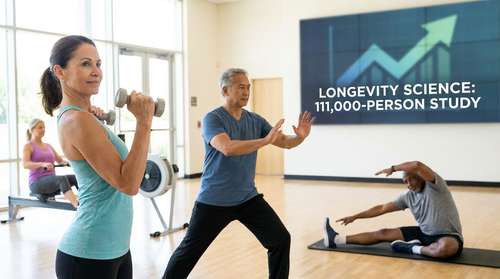
If you have been religiously sticking to the same treadmill routine for years, it might be time for a change—not just for your boredom, but for your lifespan. A massive new analysis discussing findings from a landmark 111,000-person study published in BMJ Medicine has sparked a global conversation this week, revealing that exercise variety is a more powerful predictor of longevity than previously thought. The study, which has dominated health headlines in the last 48 hours following fresh expert commentary, suggests that mixing aerobic, strength, and mobility training can reduce the risk of premature death by nearly 20%.
The Power of Hybrid Training: Beyond the Routine
For decades, public health guidelines have focused on how much you exercise. Now, science is pivoting to how you exercise. The study, conducted by researchers at the Harvard T.H. Chan School of Public Health, analyzed 30 years of data from the Nurses' Health Study and the Health Professionals Follow-Up Study. The findings are a wake-up call for creatures of habit: individuals who engaged in a diverse mix of physical activities—dubbed "hybrid training" by fitness experts—saw significantly better health outcomes than those who stuck to a single mode of fitness.
According to the data, participants with the most varied routines enjoyed a 19% lower risk of all-cause mortality. Even more striking is the impact on specific conditions. Those who combined different forms of movement achieved up to a 41% decrease in mortality risk from cardiovascular and respiratory diseases compared to those with stagnant, repetitive routines. This suggests that the body adapts to monotony, and "shocking" the system with variety is key to long-term resilience.
Why Your Heart Loves Confusion
The concept of "muscle confusion" was once dismissed as "bro-science," but this study validates the underlying principle for cardiovascular health. Different activities challenge the body in unique ways. Running strengthens the heart's pumping capacity, while strength training remodels the vascular system to handle pressure, and yoga improves arterial flexibility.
"People naturally choose different activities over time," notes Dr. Yang Hu, a lead researcher on the study. "But consciously deciding to mix diverse activities—like racket sports for coordination, swimming for metabolic health, and weights for bone density—creates a compounding effect that a single sport cannot replicate."
The Winning Combination
What does an optimal "variety protocol" look like? The study highlighted specific activities that, when combined, offered the highest protection:
- Racquet Sports: Linked to a 15% lower risk of death, likely due to the high-intensity intervals and social engagement.
- Walking & Running: Fundamental movements that provided a 13-17% risk reduction.
- Strength Training: Essential for preserving muscle mass and metabolic function.
The magic happens when you combine them. A runner who adds two days of lifting and a weekend tennis match is effectively "cross-training" their longevity genes.
Quality Over Quantity: The Plateau Effect
One of the most reassuring findings for busy professionals is the "plateau effect." The study found that the benefits of exercise variety don't require spending hours in the gym every day. In fact, mortality reduction benefits tended to level off after about 20 MET-hours per week (roughly equivalent to 3-4 hours of moderate activity).
This news, circulating rapidly in longevity science circles this week, challenges the "more is better" mentality. It shifts the goalpost from volume to diversity. Instead of trying to run 50 miles a week, you might get better longevity returns from running 15 miles, lifting weights twice, and doing a yoga session. This approach not only reduces overuse injuries—a common reason people stop exercising—but also ensures that different biological systems (neuromuscular, cardiovascular, and metabolic) are all being stimulated.
How to Pivot to a 'Longevity Mix' Today
Transforming your routine doesn't mean abandoning what you love; it means accessorizing it. If you are a devoted runner, the science suggests swapping one long run for a session of resistance training or a high-skill sport like pickleball or squash. If you are a weightlifter, incorporating zone 2 cardio (like brisk walking or cycling) is the missing link to maximizing your lifespan.
The message from the latest analysis is clear: specialization is for professional athletes; variety is for those who want to live longer. By becoming a "jack of all trades" in the gym, you aren't just building a better body—you are engineering a longer life.