February 20, 2026 – In a landmark move that signals the end of the "cardio-only" weight loss era, a coalition of leading health clinicians and global fitness organizations has officially released the 2026 'Muscle-First' Training Guidelines. These new protocols, unveiled this week, are designed specifically to address the critical issue of sarcopenic obesity among the estimated 40 million Americans now using GLP-1 agonists like Ozempic, Wegovy, and Zepbound.
The guidelines mark a decisive pivot in how the medical community approaches pharmacological weight management. For the first time, prescribers are being advised to treat resistance training not as an optional lifestyle suggestion, but as a mandatory prescription alongside the medication itself. The goal is clear: to halt the alarming trend where 25-40% of weight lost on these drugs comes from lean muscle tissue rather than fat.
The End of the 'Cardio-First' Era
For decades, the standard advice for weight loss focused heavily on caloric restriction and aerobic activity. However, the rapid weight reduction facilitated by GLP-1 medications has exposed the flaws in this approach. "We are seeing patients lose 50 pounds in six months, but 15 to 20 pounds of that is often functional muscle tissue," says Dr. Elena Rostova, a clinical endocrinologist involved in drafting the new consensus. "The result is a lower number on the scale, but a compromised metabolism and increased frailty risk. The 'Muscle-First' protocols are our answer to this metabolic crisis."
The 2026 guidelines explicitly recommend prioritizing hypertrophy-focused resistance training over steady-state cardio for GLP-1 users. This shift aims to stimulate muscle protein synthesis, which is often dampened when patients are in the steep caloric deficit that these appetite-suppressing drugs create.
Inside the 2026 'Muscle-First' Guidelines
The new protocols offer granular, actionable advice that differs significantly from general physical activity guidelines. The core pillars of the 'Muscle-First' approach include:
1. Mandatory Resistance Training Frequency
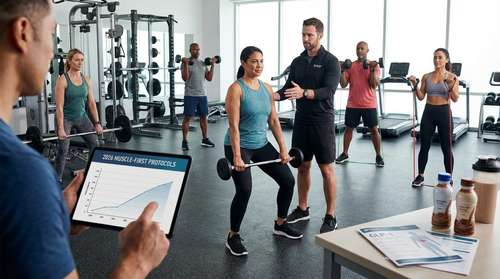
The guidelines stipulate a minimum of two to three dedicated resistance training sessions per week. Unlike previous advice that allowed for light weights or high reps, the new protocols call for "progressive overload"—gradually increasing weight or resistance to create sufficient mechanical tension. This is identified as the primary signal the body needs to retain muscle mass while shedding fat.
2. The '1.6' Protein Standard
Nutritional support is the second pillar. The protocols recommend a protein intake of 1.2 to 1.6 grams per kilogram of body weight daily for GLP-1 users. This is significantly higher than the standard RDA, reflecting the increased need to protect lean tissue during rapid weight loss. "Patients often have little appetite, so every bite must be functional," explains sports nutritionist Marcus Thorne. "We are prescribing targeted protein distribution—ensuring patients hit a 30-gram threshold at least three times a day to maximize muscle retention."
Combatting Ozempic Muscle Wasting
The urgency behind these new GLP-1 fitness protocols stems from accumulating data regarding body composition changes. Clinical data presented in late 2025 highlighted that without intervention, the loss of lean mass can lead to a condition known as "sarcopenic obesity"—where an individual has a normal BMI but dangerously low muscle mass and high body fat percentage.
This phenomenon, colloquially dubbed "Ozempic face" or "Ozempic body," is more than aesthetic. Muscle tissue is metabolically active; losing it lowers the body's resting metabolic rate, making long-term weight maintenance significantly harder. By adopting the 'Muscle-First' strategy, patients can preserve their metabolic engine, ensuring that the weight they lose is primarily adipose tissue.
The Fitness Industry's Response
The release of these guidelines has triggered an immediate response across the fitness sector. Major gym chains are already rolling out specialized "GLP-1 Companion" memberships, which include access to trainers certified in these specific Wegovy workout guidelines. These programs focus on compound movements like squats, deadlifts, and presses—exercises proven to yield the highest return on investment for muscle preservation.
Furthermore, we are seeing a convergence of healthcare and fitness, with doctors now able to refer patients directly to "medical fitness" programs that adhere to the 2026 standards. This integration ensures that the millions of patients navigating their weight loss journey have a safety net that protects their strength and longevity.
Looking Ahead: The Future of Medical Weight Loss
As we move further into 2026, the conversation around GLP-1 agonists has matured. It is no longer just about how much weight you can lose, but the quality of that weight loss. The 'Muscle-First' protocols represent a sophisticated evolution in our understanding of health, acknowledging that muscle is the currency of longevity. For patients, the message is empowering: the medication is the tool to manage appetite, but the training is the medicine for your metabolism.