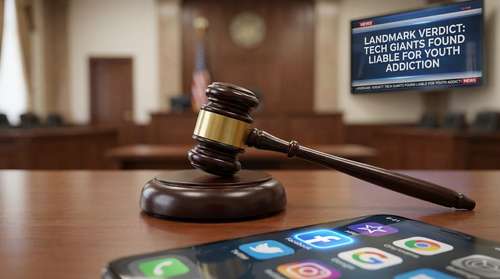
On Wednesday, a Los Angeles jury delivered a devastating legal blow to the technology industry, finalizing what legal experts are widely calling Silicon Valley's 'Big Tobacco' moment. In a historic social media addiction verdict, jurors found Meta and Google liable for deliberately designing platforms that triggered severe psychological harm in a young user. The $6 million judgment marks the first time a U.S. court has held tech conglomerates financially accountable for the psychiatric toll their algorithms exact on developing brains.
Inside the Meta Google Mental Health Lawsuit
The trial centered on a 20-year-old plaintiff identified in court documents as KGM, who testified that her continuous exposure to YouTube from age six and Instagram from age nine led to paralyzing anxiety, depression, and body dysmorphia. This Meta Google mental health lawsuit is uniquely consequential because it bypassed traditional internet liability shields. Rather than focusing on harmful user-generated content—which is largely protected under Section 230 of the Communications Decency Act—plaintiffs successfully argued that the underlying architecture of the apps themselves is fundamentally defective.
After more than 40 hours of deliberation, the panel concluded that features like infinite scroll, autoplaying videos, algorithmic recommendations, and relentless push notifications were not accidental byproducts of the user experience. Instead, they were engineered to foster compulsive use. The jury assigned 70% of the liability to Meta and 30% to Google, splitting the $3 million compensatory and $3 million punitive damages accordingly.
Decoding the Instagram Addictive Design Lawsuit
The six-week trial brought high-profile executives, including Meta CEO Mark Zuckerberg and Instagram head Adam Mosseri, to the witness stand. Plaintiff attorneys presented explosive internal research suggesting company leadership knew their platforms hooked kids but consistently prioritized engagement metrics over adolescent well-being.
During the proceedings, the plaintiff's legal team introduced a Meta-sponsored study revealing that teenagers who had experienced prior emotional trauma were highly vulnerable to platform addiction. The evidence also highlighted that traditional parental control features are largely ineffective once dependency takes hold. Additional internal communications presented in court featured an employee comparing the application to a narcotic, bluntly referring to the company as 'basically pushers'.
Jurors were apparently swayed by this mounting evidence of corporate negligence. They found that both companies acted with 'malice, oppression, or fraud'. This Instagram addictive design lawsuit laid bare the internal mechanisms of algorithmic amplification, with legal advocates comparing the platforms to behavioral Skinner boxes designed to exploit the psychological vulnerabilities of minors. Google attempted to distance itself from the controversy, arguing that YouTube is a safely built streaming service rather than a social network, but the jury firmly rejected that distinction.
Establishing a Youth Mental Health Legal Precedent
The financial penalty may seem like a rounding error for trillion-dollar tech conglomerates, but the youth mental health legal precedent it establishes threatens to upend the entire industry. This Los Angeles decision was a 'bellwether' trial—a highly scrutinized test case selected from a massive pool of over 1,600 consolidated complaints filed by teenagers, families, and public school districts nationwide.
Legal analysts anticipate this decisive victory will open the floodgates for mass litigation across the country. Two other prominent defendants originally named in KGM's suit, TikTok and Snap, opted to settle for undisclosed sums before opening statements even began, likely seeking to avoid the public exposure of a jury trial. Furthermore, the verdict arrived just 24 hours after a separate New Mexico jury ordered Meta to pay a staggering $375 million civil penalty for violating state child exploitation laws and allegedly misleading consumers about platform safety. The speed and severity of these consecutive legal defeats indicate that juries are rapidly losing patience with Silicon Valley's standard defense strategies.
The Broader Impact of the Teen Depression Social Media Ruling
The cultural and legal landscape surrounding internet access is shifting rapidly. School districts across the country are already implementing strict smartphone bans, and federal lawmakers are aggressively pushing for tighter regulations. This teen depression social media ruling arms safety advocates with judicial backing, proving that platforms can no longer dismiss the youth mental health crisis as a complex, multifaceted issue entirely disconnected from screen time.
Moving forward, the industry faces an existential threat to its business model. To avoid future liability, platforms may be forced to implement sweeping changes, including:
- Disabling autoplay and infinite scroll functionality for minor accounts.
- Eliminating algorithmic feeds in favor of chronological timelines.
- Introducing mandatory digital curfews and stricter age verification protocols.
- Removing beauty filters that contribute to body dysmorphia.
Both Meta and Google have confirmed they will appeal the decision, maintaining that scientific consensus does not definitively link digital platform usage to psychiatric disorders. However, for the families navigating the devastating realities of adolescent depression, this landmark social media liability ruling validates what they have argued for years: the engagement machine is broken, and the companies pulling the levers are finally being held to account.