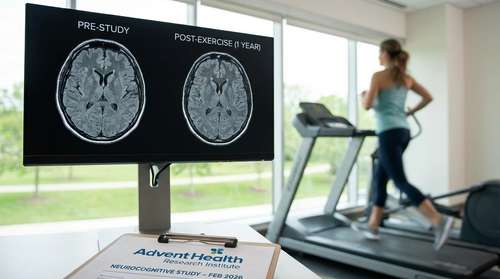
In a groundbreaking development for cognitive longevity, a landmark study released today, February 22, 2026, provides definitive biological proof that your workout routine does more than just build muscle—it actively turns back the clock on your brain. Researchers at the AdventHealth Research Institute have demonstrated that middle-aged adults who adhered to a one-year aerobic exercise regimen successfully reversed their biological brain age by nearly a full year. This new research, published in the prestigious Journal of Sport and Health Science, uses advanced MRI technology to quantify how sweat equity translates directly into neuroprotection.
The Science of Reversing Brain Age
The study focuses on a sophisticated metric known as brain-predicted age difference (brain-PAD). Unlike your chronological age, which advances relentlessly, your biological brain age is flexible. Using machine learning algorithms to analyze structural MRI scans, scientists can determine if a person’s brain looks "older" or "younger" than their actual age. A higher brain-PAD is typically associated with cognitive decline and a higher risk of dementia.
"We found that a simple, guideline-based exercise program can make the brain look measurably younger over just 12 months," explains Dr. Lu Wan, the study's lead author and a data scientist at AdventHealth. While previous research has hinted at the cognitive benefits of movement, this is one of the first randomized clinical trials to show a quantifiable biological reversal of aging markers in midlife adults, rather than just slowing the decline in seniors.
A Year of Cardio vs. A Year of Aging
The trial followed 130 healthy but sedentary adults ranging from age 26 to 58. Participants were split into two groups: one maintained their usual lifestyle, while the other committed to moderate-to-vigorous aerobic exercise for 150 minutes per week. After 12 months, the MRI results painted a striking picture of two diverging paths.
- The Sedentary Group: Their brains followed the typical aging trajectory, showing a slight increase in biological age (approximately +0.35 years).
- The Exercise Group: Their brains biologically "got younger," showing a decrease in brain-PAD by an average of 0.60 years.
When combined, the net difference between the groups was nearly a full year (0.95 years). "From a lifespan perspective, nudging the brain in a younger direction in midlife could be very important," notes Dr. Kirk I. Erickson, the study's senior author and Director of Translational Neuroscience at AdventHealth. This suggests that the window to protect against Alzheimer’s and cognitive decay opens much earlier than previously thought—decades before the first symptom appears.
Why Midlife is the Critical Window
Most brain aging MRI studies focus on the elderly, but this research highlights the critical importance of intervention during early and middle adulthood. The participants weren't suffering from memory loss; they were healthy individuals in the prime of life. The findings imply that waiting until retirement to prioritize neuroprotective workouts may be missing a crucial preventative opportunity. By starting in your 30s, 40s, or 50s, you aren't just maintaining the status quo; you are actively building a "cognitive reserve" that buffers against future pathology.
How to Train for a Younger Brain
The protocol used in the study wasn't an extreme athlete's regimen; it was achievable for the average person. The goal was 150 minutes of aerobic activity per week—roughly 30 minutes a day, five days a week. The key was intensity: the exercise needed to be moderate-to-vigorous. This means an activity that raises your heart rate and breathing speed significantly, such as brisk walking, running, cycling, or swimming.
For those looking to replicate the study's success, consistency is more important than intensity. The participants didn't see results overnight; the biological restructuring of the brain took a full 12 months of sustained effort. The study confirms that aerobic exercise benefits extend beyond cardiovascular health, acting as a powerful medicine for the central nervous system.
The Future of Cognitive Longevity
As we move further into 2026, this research challenges the inevitability of mental decline. It provides a hopeful, actionable message: you have agency over your brain's biological clock. While we cannot stop the calendar years from passing, this AdventHealth fitness research proves that with a pair of running shoes and a year of dedication, we can biologically reverse the wear and tear on our most vital organ.