In a landmark shift for American education, new impact reports released in early 2026 reveal that strict "bell-to-bell" smartphone bans in schools are delivering profound mental health benefits. The latest data indicates a staggering 25% decrease in reported adolescent social anxiety in districts that have implemented complete device restrictions. As legislative momentum builds in states like Connecticut, this statistical breakthrough is fueling a nationwide phone-free schools movement, offering a potential turning point in the ongoing youth mental health crisis 2026.
The 'Anxious Generation' Trends: A Turning Point?
For years, educators and psychologists have warned of the correlation between rising screen time and declining student well-being. The release of The Anxious Generation by social psychologist Jonathan Haidt laid the theoretical groundwork, but 2026 has brought the hard data policymakers have been waiting for. The new report, which aggregates data from pilot programs across three states and mirrors similar successes in Australia, suggests that removing the constant tether of digital socialization during school hours acts as a critical "circuit breaker" for stressed adolescents.
"We are seeing a clear pattern," says Dr. Sarah Jenkins, a lead researcher on the study. "When you remove the device, you remove the performative pressure. That 25% drop isn't just a number; it represents thousands of students who are engaging more with their peers and feeling less scrutinized during their learning day." This data challenges earlier, more mixed findings, suggesting that half-measures—like allowing phones during lunch—fail to provide the necessary digital detox for adolescents that full bans achieve.
Connecticut Leads the Legislative Charge
Nowhere is this momentum more visible than in Connecticut. Governor Ned Lamont has thrown his full weight behind a statewide push for "bell-to-bell" restrictions, supported by the newly formed "Phone-Free CT" coalition. The coalition, comprised of teachers, parents, and mental health experts, argues that the school cell phone ban benefits extend far beyond better test scores.
From Legislation to Implementation
The proposed legislation, debated fiercely in the 2026 session, aims to standardize what has previously been a patchwork of district policies. "We can't have a situation where one district protects its students' focus while the neighboring one leaves them vulnerable to the algorithm," stated a representative from the Connecticut Education Association. Schools in Manchester, CT, which adopted early bans, are already reporting "significant" improvements, including fewer physical altercations and a tangible rise in classroom engagement—a real-world validation of the adolescent depression recovery trends hinted at in national data.
Student Perspectives: The Rise of 'Appstinence'
Surprisingly, the push isn't entirely top-down. A growing counter-culture among Gen Z students is embracing the concept of a "dumb phone" lifestyle. Known as the "Appstinence" movement, student-led groups are voluntarily trading smartphones for basic handsets to reclaim their attention spans.
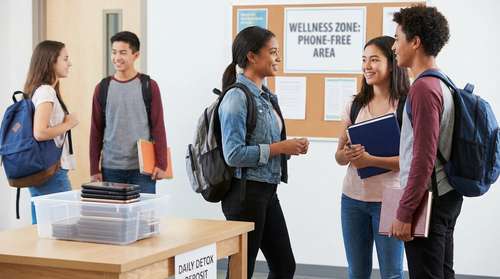
"At first, I hated the ban," admits Jaden, a high school junior in a pilot district. "But after a month, I realized I wasn't constantly checking to see if I was being left out of something. The student anxiety and smartphones link is real. I actually talk to people at lunch now." This shift suggests that while the transition is painful, the relief from constant digital connectivity is a welcome change for many teens caught in the cycle of notification fatigue.
Navigating the Digital Detox Debate
Despite the promising 25% statistic, the movement faces hurdles. Critics point to studies like a 2025 report from The Lancet which found less conclusive evidence on mental health outcomes from phone bans. However, proponents argue that those studies often evaluated inconsistent bans that allowed loophole usage. The new 2026 data specifically isolates "bell-to-bell" environments—where phones are locked away or completely prohibited from arrival to dismissal—identifying this total separation as the key variable for success.
As more states review this latest evidence, the question is shifting from "should we ban phones?" to "how quickly can we implement this?" For a generation defined by anxiety, the classroom might finally be becoming a sanctuary of focus and genuine connection once again.