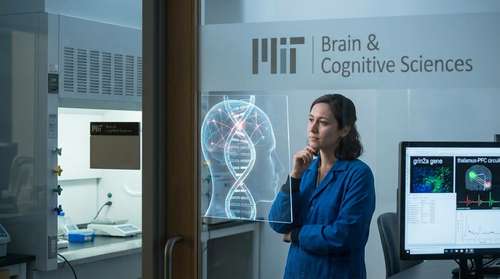
For individuals living with schizophrenia, the world can often feel like a puzzle where the pieces constantly shift but the picture never updates. While clinical treatments have long focused on managing hallucinations and delusions, one of the most debilitating symptoms of the disorder remains profoundly difficult to treat: the loss of cognitive flexibility. This refers to the brain’s natural ability to update its beliefs when presented with new evidence. Now, an MIT mental health study 2026 has uncovered the precise biological mechanism behind this phenomenon. Researchers have identified a specific genetic mutation that effectively traps the brain in an outdated version of reality, shedding light on why so many individuals struggle to integrate fresh sensory input.
The Biology of a Stalled Reality
In neurotypical individuals, the brain acts as a highly efficient prediction machine. When environmental factors change, the mind swiftly recalculates, discarding prior assumptions for updated facts. This reality-checking mechanism frequently misfires in those with schizophrenia, forcing patients to rely on obsolete information. This mental health breakthrough news comes courtesy of an April 2026 collaborative effort led by neuroscientists at the Massachusetts Institute of Technology and Tufts University, who pinpointed a genetic anomaly as a primary culprit for this cognitive roadblock.
The research builds on earlier massive genetic sweeps, specifically looking at the grin2a gene. This gene carries critical instructions for building a protein that forms part of the NMDA receptor. Situated on the surface of neurons, these receptors react to the neurotransmitter glutamate and facilitate the rapid neural signaling required for complex thought. When researchers engineered a mouse model carrying the grin2a gene mutation schizophrenia patients often exhibit, the animals demonstrated severe deficits in adapting to changing scenarios.
The Behavioral Impact of the Mutation
During specialized behavioral tests designed to measure adaptive thinking, mice were tasked with a high-reward versus low-reward lever challenge. When the effort required to earn the reward shifted, neurotypical mice quickly adapted their strategy. The mutated mice, however, repeatedly stuck to their old patterns long after those strategies stopped yielding benefits, essentially locked into an outdated belief system.
Mapping the Brain Circuit for Flexible Decision Making
To understand exactly where the communication breakdown occurs within the brain's architecture, the research team utilized advanced functional ultrasound imaging combined with in vivo electrical recordings. They traced the dysfunction to a specific region known as the mediodorsal thalamus. This small but critical structure acts as a central switchboard, connecting directly with the prefrontal cortex. Together, they form a thalamocortical pathway that regulates executive functions, tracks the shifting value of different choices, and orchestrates the brain circuit flexible decision making relies upon.
The latest thalamus prefrontal cortex research indicates that the grin2a mutation leaves the mediodorsal thalamus severely hypofunctional. Without strong, accurate signals firing from this hub, the prefrontal cortex receives no alert that the external environment has changed. Consequently, the brain's internal ledger is never updated, cementing a rigid worldview that heavily resists contradictory evidence.
Flipping the Switch: Reversing Cognitive Rigidity
Identifying the biological root of cognitive rigidity is a massive leap forward, but the research team, including lead authors Tingting Zhou and Guoping Feng, took their investigation a crucial step further. By utilizing optogenetics—a technique that involves engineering specific neurons to fire in response to light—the scientists artificially stimulated the sluggish mediodorsal thalamus in the mutated mice. The results were immediate and striking.
Once the circuit was artificially reactivated, the animals regained their cognitive flexibility. They began adapting to the maze's shifting rewards just as rapidly as their neurotypical counterparts. This successful behavioral reversal provides a clear, biological blueprint for schizophrenia cognitive rigidity treatment. “If this circuit doesn't work well, you cannot quickly integrate information,” noted Feng, the Poitras Professor in Brain and Cognitive Sciences at MIT. By proving that the damage is not permanent and the circuitry can be effectively “rebooted,” scientists have opened up entirely new avenues for therapeutic intervention.
Looking Ahead to New Mental Health Treatments 2026
While only a small subset of schizophrenia patients possess this exact grin2a mutation, the clinical implications of this discovery extend far beyond a single genetic profile. The impairment of the thalamocortical circuit likely represents a shared neurological bottleneck for many individuals dealing with psychosis and cognitive decline, regardless of their specific genetic makeup.
Currently, the most common antipsychotic medications on the market primarily target dopamine receptors to quiet hallucinations, leaving cognitive symptoms largely unaddressed. The search is now firmly focused on discovering pharmacological agents capable of mimicking the effects of the optogenetic light switch used in the laboratory. By pinpointing the exact cellular targets within the mediodorsal thalamus, pharmaceutical researchers aim to design highly specific drugs that enhance this circuit's activity without triggering unwanted side effects in other regions of the brain. As the landscape of new mental health treatments 2026 continues to rapidly evolve, targeted therapies designed to untrap the mind and restore cognitive agility may soon move from the laboratory into mainstream clinical practice.