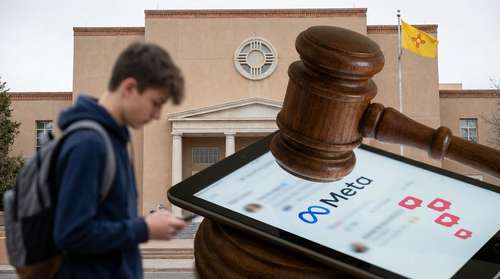
The legal shield protecting social media giants just took a historic blow. On March 24, 2026, a Santa Fe jury ordered the parent company of Facebook and Instagram to pay $375 million in civil penalties, culminating a landmark Meta lawsuit child mental health battle. Jurors found the tech titan knowingly violated state consumer protection laws by prioritizing corporate profits over the psychological well-being and safety of its youngest users.
After a grueling seven-week trial, the New Mexico Meta verdict marks the first time a US jury has held the conglomerate financially liable for the psychological damage linked to its platforms. New Mexico Attorney General Raúl Torrez, who spearheaded the 2023 litigation, called the decision a resounding victory for families everywhere. During closing arguments, state prosecutors presented evidence suggesting executives were fully aware of the dangers their platforms posed but actively concealed them from the public.
Unpacking the $375 Million New Mexico Meta Verdict
Jurors determined that the company committed 75,000 distinct violations of the state's Unfair Practices Act. At the maximum penalty of $5,000 per infraction, the total fine reached $375 million. The jury agreed that Meta engaged in "unconscionable" trade practices, making misleading statements regarding safety protocols and taking unfair advantage of inexperienced users.
Before reaching their conclusion, the jury systematically reviewed a detailed checklist of allegations. They found the corporation liable for failing to address critical issues, including:
- Enforcing bans on users under the age of 13
- Disclosing the alarming prevalence of content promoting teen suicide
- Addressing how proprietary algorithms prioritize sensationalized, dangerous material
- Mitigating the clear and present impacts on youth psychological well-being
The state's case featured harrowing evidence, including a sophisticated undercover investigation. Law enforcement agents created social media profiles posing as young teenagers to document precisely how the platforms responded to minors. The results were chilling: agents recorded how quickly predators could initiate contact and solicit explicit material, exposing severe flaws in safety nets. Prosecutors successfully argued that the company failed to deploy adequate safeguards against child sexual exploitation, choosing instead to operate systems that fed harmful content directly to vulnerable minors to maintain high engagement rates.
Social Media Addiction Teens Face and the Instagram Impact on Youth
Central to the trial was the undeniable Instagram impact on youth and the mechanisms designed to keep users perpetually scrolling. While corporate attorneys pushed back against the formal existence of social media addiction teens experience, executives on the stand conceded to seeing patterns of "problematic use" among their user base.
The proceedings laid bare the mechanics driving the youth mental health crisis 2026 is currently facing. By prioritizing engagement metrics above all else, algorithms push vulnerable young people toward rabbit holes of harmful material, including content related to eating disorders and self-harm. State prosecutors successfully established that the design choices fueling addictive behaviors were deliberate, calculated features to maximize screen time rather than accidental glitches.
Classrooms Bear the Brunt of the Crisis
The fallout from these addictive algorithms extends far beyond individual households. Throughout the trial, educators highlighted how the platform's nature disrupts learning environments nationwide. The trial comes at a critical juncture, as school districts across the country desperately seek more restrictions on the use of smartphones in classrooms to combat plummeting attention spans and rising anxiety rates. The verdict validates the daily struggles teachers face when trying to educate a generation perpetually distracted by algorithmic feeds.
Big Tech Mental Health Accountability and the Road Ahead
A corporate spokesperson immediately announced plans to appeal the decision, stating the company works rigorously to remove bad actors and defend its record of protecting teens online. During the proceedings, defense attorneys argued that the company actively discloses risks and expends significant resources to weed out harmful experiences, contending that no safety net is entirely foolproof. Despite the massive penalty, Wall Street barely blinked; the stock rose 5% in after-hours trading, reflecting the fact that the fine is a fraction of the more than $2 billion prosecutors initially sought from the $1.5 trillion conglomerate.
However, the financial penalty is only the beginning of this reckoning for Big Tech mental health accountability. On May 4, a second phase of the trial will commence before Judge Bryan Biedscheid without a jury. This bench trial will determine whether the company's platforms constitute a "public nuisance". If the state prevails again, the court could issue injunctions forcing fundamental design changes or require the company to fund localized public health programs.
The Ripple Effect on Social Media Safety Laws
This Santa Fe courtroom drama is not an isolated incident. The verdict has effectively opened the floodgates for further litigation. More than 40 other state attorneys general have filed similar lawsuits waiting in the wings. Meanwhile, a federal jury in Los Angeles County is currently deliberating a comparable case involving multiple tech giants.
Legal experts view this rapid succession of litigation as a powerful catalyst for sweeping social media safety laws. As courts increasingly pierce the long-standing protections of Section 230 of the Communications Decency Act—which the New Mexico judge notably rejected as a shield for algorithmic choices—lawmakers are feeling emboldened to draft stricter regulations regarding age verification, algorithmic transparency, and parental controls.
For parents, educators, and youth advocates, the ruling offers tangible proof that tech behemoths are no longer legally untouchable. As the dust settles, the technology industry is waking up to a new reality where the psychological safety of children carries a very real, very public price tag.