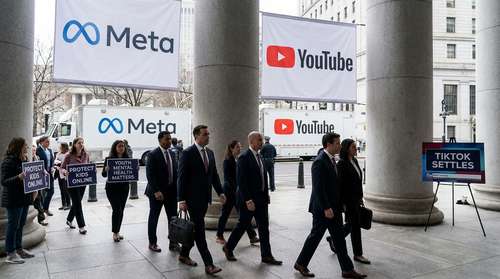
Two of the world's most powerful technology giants, Meta and YouTube, are officially standing trial today in a landmark case that could redefine the legal liability of social media platforms. As proceedings continue in the Los Angeles County Superior Court this Wednesday, January 28, 2026, the focus has narrowed sharply on these two industry leaders following a surprise last-minute settlement by TikTok. The social media mental health lawsuit accuses the companies of deliberately engineering their algorithms to fuel social media addiction in teens, prioritizing corporate profits over the safety and well-being of millions of children.
TikTok Exits Litigation as Meta and YouTube Stand Alone
Just 24 hours before opening statements were set to captivate the tech world, TikTok reached a confidential settlement with the plaintiffs, effectively bowing out of what legal experts are calling the "tobacco moment" for Big Tech. The short-form video giant joined Snapchat's parent company, Snap Inc., which settled its portion of the case last week. The sudden TikTok settlement 2026 leaves Meta (parent of Instagram and Facebook) and YouTube (owned by Alphabet) as the sole defendants facing a jury.
Legal analysts suggest TikTok's move was calculated to avoid the public airing of internal documents and executive communications that are expected to be revealed during the trial. "Settling allows these platforms to control the narrative and keep their proprietary algorithms out of the public record," noted a source familiar with the proceedings. However, Meta and YouTube have chosen to fight the allegations, setting the stage for a grueling weeks-long battle that will scrutinize their internal safety measures.
The "Bellwether" Case: A 19-Year-Old's Battle
At the center of this historic Meta YouTube child safety trial is a 19-year-old plaintiff identified in court documents only by her initials, K.G.M. Her legal team argues that she developed severe teen depression from social media use, spiraling into anxiety and suicidal ideation after becoming addicted to the platforms as a minor. Lawyers for K.G.M. contend that the addiction was not an accident but the result of "defective design"—features like infinite scroll, intermittent variable rewards, and aggressive push notifications that exploit the developing brains of adolescents.
"These companies borrowed the playbook from the tobacco industry," said lead counsel Mark Lanier in a pre-trial statement. "They knew their products were harmful to the youth mental health crisis, yet they doubled down on engagement-maximizing features to hook children for profit." The defense is expected to argue that the platforms provide robust parental controls and that the companies cannot be held liable for how individuals choose to use their services, citing First Amendment protections.
Overcoming the Section 230 Shield
This trial is particularly significant because it circumvents the traditional liability shield known as Section 230 of the Communications Decency Act. While Section 230 protects platforms from liability for third-party content (what users post), Judge Carolyn B. Kuhl ruled that this case targets the design of the platforms themselves. By focusing on the addictive mechanics rather than specific posts, the plaintiffs have successfully brought Big Tech liability before a jury for the first time in such a high-stakes context.
A Watershed Moment for Social Media Regulation
The outcome of this trial will serve as a bellwether for thousands of similar lawsuits currently pending across the United States. School districts, state attorneys general, and thousands of families have filed claims alleging that the youth mental health crisis is directly linked to the unchecked rise of algorithmic feeds. If the jury finds Meta and YouTube liable, it could trigger a wave of damages worth billions of dollars and force a fundamental redesign of how social media apps operate.
Evidence presented is expected to include internal emails and "smoking gun" research documents showing that executives were aware of the psychological harms their products inflicted on teenagers but chose to ignore them. As jury selection wraps up and arguments begin, the tech industry is holding its breath. A verdict against Meta and YouTube would not only offer justice to K.G.M. but could also dismantle the business model of the attention economy, forcing companies to prioritize user health over engagement metrics.