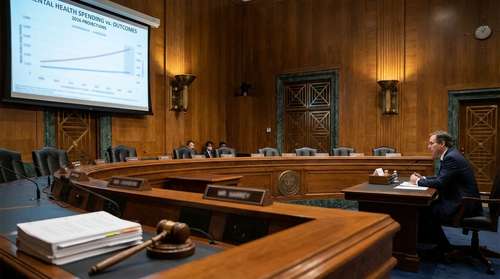
The deepening mental health crisis 2026 took center stage on Capitol Hill yesterday, as lawmakers and health experts confronted a stark reality: historic financial investments are not translating into healthier citizens. During a crucial Congressional mental health hearing on April 6, subcommittee members reviewed sobering new testimony revealing that despite roughly $75 billion in annual Medicaid mental health spending, the nation's suicide rates and psychiatric disability claims remain critically high. The findings have ignited a bipartisan demand for sweeping reforms and a fundamental shift toward holding care providers accountable for actual patient recovery rather than mere facility attendance.
Federal Funding vs. Patient Outcomes: A Growing Disconnect
Medicaid has long served as the primary payer for mental health and substance use care in the United States, bearing an immense financial responsibility. Policy research indicates that Medicaid historically allocates over $58 billion toward mental health services and $17 billion for substance use care annually. Yet, this combined $75 billion safety net is facing unprecedented scrutiny from legislators who demand a better return on taxpayer investment. At Monday's roundtable, clinical experts testified that simply pouring more capital into the existing, fractured framework is insufficient to halt the current clinical trajectory.
Lawmakers reviewed startling demographic data concerning vulnerable populations. Recent figures demonstrate that millions of youth experience major depressive episodes or substance use disorders annually, and Medicaid shoulders the burden for nearly half of those affected adolescents. Despite this sweeping coverage, psychiatric treatment outcomes have largely flatlined or, in some demographics, actively worsened. Emergency room visits for severe anxiety, suicidal ideation, and acute psychotic breaks continue to overwhelm local hospital networks from coast to coast. Witness testimony emphasized that while expanding access was a noble goal of previous administrations, the system completely failed to establish adequate benchmarks to measure whether that access was actively healing patients or just creating a revolving door of treatment.
The Core Issue: Volume Over Value
A central theme of the Congressional mental health hearing was the structural flaw in how behavioral healthcare is reimbursed at both the state and federal levels. Currently, most programs utilize a fee-for-service model, paying facilities for each individual therapy session, overnight bed day, or prescribed medication. This traditional model heavily incentivizes volume and occupancy over actual recovery.
The Need for Healthcare Transparency
Experts argued that healthcare transparency remains dismally low across the behavioral health sector, masking the severity of the problem. When patients enter inpatient or outpatient treatment programs, families have virtually zero data to determine the facility's historical success rate. The lack of standardized, national tracking means that highly ineffective treatment centers continue to receive massive federal dollars as long as they meet basic compliance and safety standards, completely regardless of their long-term clinical efficacy or the relapse rates of their discharged patients.
The Push for Outcome-Based Mental Health Care
To actively reverse the tide of the mental health crisis 2026, policymakers are forcefully pivoting the conversation toward outcome-based mental health care. This proposed reimbursement model would tie federal funding directly to measurable patient progress rather than procedural volume. Under an outcome-based or value-based system, clinical providers would receive financial incentives only when patients achieve specific, verifiable milestones.
- Sustained local employment or academic reintegration.
- Fewer psychiatric hospital readmissions within a twelve-month period.
- Documented clinical reductions in symptom severity using standardized psychiatric rating scales.
Subcommittee members debated several potential pilot programs that could reshape Medicaid reimbursements across all fifty states. These initiatives include implementing mandatory reporting metrics for all facilities receiving federal funds and creating substantial financial bonuses for integrated care models. Integrated models, which treat a patient's physical and psychiatric symptoms simultaneously under one roof, have shown significant promise in early clinical trials.
Navigating Mental Health Reform 2026
The aggressive push for mental health reform 2026 is expected to dominate legislative health agendas for the remainder of the calendar year. Lawmakers are currently drafting comprehensive bipartisan bills aimed at overhauling the Substance Abuse and Mental Health Services Administration guidelines. They also plan to restructure Medicaid billing codes to finally reflect an outcome-driven philosophy.
While patient advocacy groups widely support the shift toward strict clinical accountability, some rural and safety-net providers expressed valid concerns during the hearing. They warned the subcommittee that tying funds directly to outcomes could unintentionally penalize underfunded clinics taking on the most complex, severely ill patients who traditionally have lower statistical recovery rates. To address this legitimate disparity, the forthcoming legislation will likely include complex risk-adjustment formulas. These formulas would ensure that clinics treating highly vulnerable, chronically homeless, or heavily addicted populations are graded on a fair demographic curve rather than a rigid national average.
The April 6 roundtable served as a clear, unequivocal warning shot to the behavioral health industry. The era of unchecked federal spending without verifiable clinical results is rapidly drawing to a close. As Congress moves aggressively to reshape the sprawling landscape of psychiatric care, the ultimate goal remains crystal clear: building an accountable system where a $75 billion annual investment actually buys a healthier, more resilient nation.