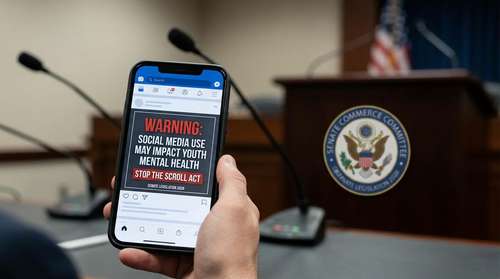
The digital landscape for younger users is facing a massive regulatory shift. On Tuesday, April 14, 2026, the U.S. Senate Commerce Committee officially advanced the Stop the Scroll Act. This major bipartisan legislation targets the algorithms driving our youth into endless engagement loops by mandating strict social media warning labels for anyone under the age of 18. Led by Senators Katie Britt (R-AL) and John Fetterman (D-PA), the bill forces tech giants to clearly disclose the potential psychological dangers of their platforms. If signed into law, apps like TikTok, Snapchat, and Instagram will look fundamentally different for teenagers, offering friction points designed to break the cycle of digital dependency.
Inside the Bipartisan Push for Youth Mental Health Legislation 2026
Finding middle ground in Washington is notoriously difficult, but protecting minors online has bridged the partisan divide. The swift movement of the Stop the Scroll Act through the Senate Commerce Committee highlights a growing consensus that tech companies can no longer self-regulate.
A driving force behind the bill's momentum is the personal advocacy of its sponsors. The public conversation around John Fetterman mental health struggles has brought a unique, highly visible authenticity to the legislative effort. Fetterman has been remarkably transparent about his battles with clinical depression, publicly noting that social media often exacerbates feelings of inadequacy and anxiety. By teaming up with Senator Britt, who has championed family-focused conservative policies, the duo has framed the legislation not as a partisan attack on tech, but as a crucial public safety measure. Their united front signals that youth mental health legislation 2026 will be a defining issue for this Congress, putting immense pressure on the broader Senate to pass the measure.
How the Mandated Social Media Warning Labels Will Work
Unlike previous attempts to regulate the tech industry, the Stop the Scroll Act focuses heavily on user awareness and immediate intervention. When an adolescent opens a targeted app, they will not be immediately greeted by a curated feed. Instead, the legislation dictates that users under 18 will encounter a prominent pop-up box displaying social media warning labels—similar to the Surgeon General's warnings currently found on tobacco and alcohol products.
Before gaining access to the app's content, the minor must actively acknowledge the potential psychological risks. Crucially, the prompt goes beyond just listing dangers. The bill requires these pop-ups to provide direct, one-click access to clinical resources. For instance, a teenager experiencing a crisis could be instantly routed to the 988 Suicide and Crisis Lifeline. This turns a standard legal disclaimer into an actionable lifeline for vulnerable teens navigating the digital world.
The Role of the FTC and Enforcement
Enforcing these new regulations will be a complex undertaking. The Federal Trade Commission (FTC) would be tasked with implementing and monitoring this mandate across all applicable platforms. Tech companies that fail to comply with the stringent design requirements could face significant financial penalties. This shifts the burden of safety away from parents, who currently have to navigate a maze of disparate parental control settings, and places it squarely on the corporations designing the algorithms.
Addressing the Social Media Public Health Risk
The push for the Stop the Scroll Act stems directly from stark warnings issued by medical professionals over the last several years. The former U.S. Surgeon General explicitly recommended placing health warnings on these platforms, classifying the ongoing crisis as a severe social media public health risk.
Data supporting the initiative is alarming. Medical studies cited in the original public advisory indicate that adolescents who spend more than three hours a day on social media face double the risk of experiencing poor mental health outcomes, including severe depression and anxiety.
Teen social media addiction is largely fueled by features like infinite scrolling, auto-playing videos, and algorithmic recommendations designed to maximize watch time. Young, developing brains are uniquely susceptible to the dopamine hits these design choices provide. By interrupting the automatic transition into the feed, lawmakers hope to create a momentary cognitive break—a chance for the user to step back and evaluate their emotional state before diving into hours of content.
Will Pop-Ups Actually Curb Teen Social Media Addiction?
While the advancement of the Stop the Scroll Act marks a legislative milestone, psychiatric professionals and tech analysts remain cautious about its practical execution. A recurring question among child psychologists is whether a pop-up warning will genuinely alter adolescent behavior.
Dr. Gary Swanson, a child psychiatrist at the Allegheny Health Network, recently pointed out that a simple warning box might not physically stop a teenager from using an app. Just as adults frequently click past terms and conditions prompts without a second thought, kids might develop warning blindness and instinctively close the notification to get to their friends' videos. Some tech trade groups have already voiced opposition, suggesting that the labels might infringe on First Amendment rights by compelling speech.
However, mental health advocates argue that the legislation's true value lies in the resources provided and the cultural shift it represents. Christine Michaels, with the National Alliance on Mental Illness, noted that while some users will undoubtedly ignore the prompt, others might not—and providing an alternative site or resource in a critical moment offers a rare opportunity to make a difference. Whether the Stop the Scroll Act ultimately cures the youth mental health crisis or simply treats the symptoms, its passage out of committee proves that the era of unchecked digital expansion targeting children is drawing to a close.