If you have ever glanced at your smartwatch after a workout and felt a surge of pride at the “calories burned” number flashing on the screen, you might want to curb your enthusiasm. For years, fitness enthusiasts and researchers alike have suspected that wrist-worn trackers are generous with their estimates. Now, a breakthrough from Harvard’s School of Engineering and Applied Sciences (SEAS) confirms those suspicions and offers a powerful solution. Researchers have unveiled OpenMetabolics, a new AI-driven system that uses smartphone sensors to track energy expenditure with double the accuracy of leading commercial smartwatches.
The Hidden Flaw in Your Wrist Wearable
To understand why this new tool is such a leap forward, we first have to look at why current technology falls short. Whether you are wearing an Apple Watch, a Fitbit, or a Garmin, your device is primarily guessing your calorie burn based on proxies. It measures your heart rate and the swinging motion of your arm, then runs those numbers through a proprietary algorithm to estimate how much energy you are using.
The problem? Biology is complex, and wrist motion is a poor indicator of whole-body effort. As noted in the new research published this week in Communications Engineering, commercial smartwatches suffer from estimated error rates ranging from 30% to 80%. They often struggle to distinguish between a stressful meeting that spikes your heart rate and a brisk walk that actually burns calories. Furthermore, they frequently misinterpret upper-body movement—like washing dishes or typing—as vigorous exercise, leading to wildly inflated daily calorie counts.
Enter OpenMetabolics: Fitness Tracking Reinvented
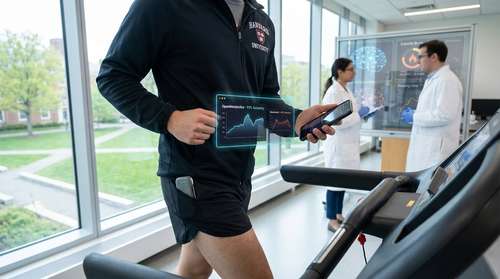
Announced on February 18, 2026, OpenMetabolics takes a radically different approach. Instead of relying on a wrist strap, the system utilizes the device nearly everyone already carries: a smartphone. Developed by a team led by Patrick Slade, assistant professor of bioengineering at Harvard SEAS, and Ph.D. student Haedo Cho, the tool uses the gyroscope and accelerometer inside a standard smartphone to measure leg motion directly from your pocket.
"Physical activity is critical for management of many aspects of health," Slade explained in a statement surrounding the release. "By relying on a smartphone-based system, this approach can be easily deployed for large-scale use and research studies, even in underserved areas."
The system is powered by a sophisticated machine learning model trained to interpret the specific biomechanics of leg movement. By analyzing the sway and stride of your legs as you walk, run, or climb stairs, OpenMetabolics can calculate the energy your muscles are actually consuming. This direct link between leg mechanics and metabolic cost is what allows the system to bypass the guesswork involved in heart-rate-based tracking.
Machine Learning Fitness App Achieves Precision
The results of the Harvard study are stark. When tested against gold-standard metabolic measurements, OpenMetabolics demonstrated a cumulative error rate of just 18% across a wide range of real-world activities. This makes it roughly twice as accurate as current state-of-the-art smartwatches.
One of the cleverest features of the system is its "pocket motion artifact correction." Anyone who has walked with a phone in loose shorts knows the device bounces around chaotically. Haedo Cho’s team developed a specific algorithm to filter out this noise, ensuring that the system captures the true trajectory of the leg rather than the random jiggle of the phone. This means the tool works effectively regardless of whether you are wearing tight jeans, gym shorts, or dress slacks.
Why Leg Sensors Beat Wrist Sensors
The superiority of leg-based tracking comes down to physiology. The large muscles in your legs consume the vast majority of energy during locomotion. Wrist movements are often decoupled from this effort—you can walk briskly with your hands in your pockets (zero wrist motion) or wave your arms wildly while sitting (high wrist motion). By moving the sensor to the thigh (via the pocket), OpenMetabolics captures the engine of human movement directly.
A Victory for Open Science
Perhaps the most significant aspect of OpenMetabolics is the "Open" in its name. Unlike the "black box" algorithms used by tech giants, which hide their calculations behind trade secrets, the Harvard team has made their entire system open-source. The code, data, and mobile application are freely available to other researchers and developers.
This is a game-changer for Harvard fitness research 2026 and beyond. Until now, scientists studying obesity, metabolism, or public health had to rely on inaccurate consumer devices or expensive, cumbersome lab equipment. OpenMetabolics provides a middle ground: a highly accurate, free tool that runs on the hardware billions of people already own.
"His work brings the technology closer to a widely deployable, commercial or high-quality research device," the university noted regarding Cho’s contribution. This democratization of health data could lead to better insights into population health trends and more effective personalized fitness plans.
The Future of Wearable Technology Breakthroughs
While OpenMetabolics is currently a research-grade tool, its implications for the consumer market are massive. We are likely to see this logic integrated into future health apps, where your phone becomes your primary fitness tracker, relegating the smartwatch to a notification center. For now, however, the message from Harvard is clear: if you want to know how many calories you really burned, the answer isn't on your wrist—it's in your pocket.