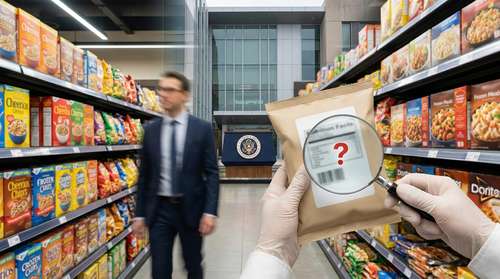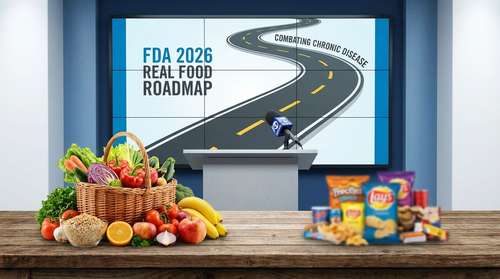
Washington is officially breaking up with Big Food. In a landmark announcement this week that signals the most significant shift in federal nutrition policy in decades, the Food and Drug Administration (FDA) released its priority deliverables for the 2026 fiscal year. The aggressive new roadmap, unveiled yesterday, operationalizes the Trump Administration's "Make America Healthy Again" (MAHA) agenda, placing a laser focus on eliminating ultra-processed foods and strictly limiting added sugars to reverse the nation's skyrocketing rates of chronic disease.
The End of the 'Standard American Diet'
For the first time in history, federal health regulators are explicitly urging Americans to turn their backs on industrial food products. The FDA's 2026 roadmap cements the principles laid out in the recently released 2025-2030 Dietary Guidelines for Americans, which controversially replaced the traditional food pyramid logic with a simple, radical directive: "Eat Real Food."
Under the guidance of Health and Human Services (HHS) Secretary Robert F. Kennedy Jr., the agency is pivoting from a calorie-obsessed model to one focused on food quality and toxicity. "We shouldn't be subsidizing people to eat poison," Kennedy stated regarding the new policy direction. The roadmap prioritizes the removal of endocrine-disrupting chemicals and artificial dyes from the food supply, marking a departure from the "generally recognized as safe" (GRAS) loophole that has allowed thousands of additives to bypass rigorous safety testing for years.
War on Ultra-Processed Foods
The centerpiece of the FDA 2026 nutrition policy is a direct offensive against ultra-processed foods (UPFs). Citing mounting evidence linking UPFs to obesity, type 2 diabetes, and metabolic dysfunction, the FDA announced it will formally define "ultra-processed" for regulatory purposes this year—a move that industry lobbyists have fought tooth and nail to prevent.
This definition will serve as the foundation for new warning labels. By late 2026, the FDA plans to finalize mandatory Front-of-Package (FOP) labeling that will clearly flag products high in added sugars, sodium, and chemical additives. Unlike previous voluntary industry systems, these labels are designed to be impossible to miss, empowering consumers to identify highly processed alternatives at a glance. The message to manufacturers is clear: reformulate your products or face the stigma of a warning label.
'Operation Stork Speed' and Infant Health
A critical component of the roadmap is the newly launched "Operation Stork Speed." This initiative aims to modernize nutrient requirements for infant formula for the first time in decades. The FDA is moving to strictly limit heavy metals and eliminate seed oils from infant nutrition products, ensuring that the youngest Americans are not exposed to inflammatory ingredients during their most critical developmental windows.
Strict New Limits on Added Sugars
The 2026 roadmap doubles down on the added sugar limits introduced in the 2025-2030 guidelines. The new policy advises that no amount of added sugar is safe for children under age four—a sharp break from previous guidance. For adults, the recommendation has been slashed to less than 5% of total daily calories, significantly lower than the previous 10% threshold.
To enforce this, the FDA is initiating a review of the "Healthy" nutrient content claim. Products containing significant amounts of added sugar or non-nutritive sweeteners will no longer be eligible to bear the "Healthy" label on their packaging. This regulatory tightening aims to close the "health halo" loophole that has allowed sugary yogurts and granola bars to masquerade as health foods.
Whole Food Health Benefits vs. Corporate Interests
The shift represents a victory for advocates of whole food health benefits over corporate interests. The new guidelines champion nutrient-dense whole foods—including high-quality proteins, eggs, and full-fat dairy—while ending the decades-long "war on fat" that many experts argue contributed to the obesity epidemic by replacing natural fats with refined carbohydrates and vegetable oils.
As the FDA begins implementing these changes, consumers can expect to see a transformation in school lunches and federal food assistance programs. The administration has signaled that future eligibility for government procurement will depend on adherence to these stricter "real food" standards, effectively forcing a cleanup of the supply chain from the top down.