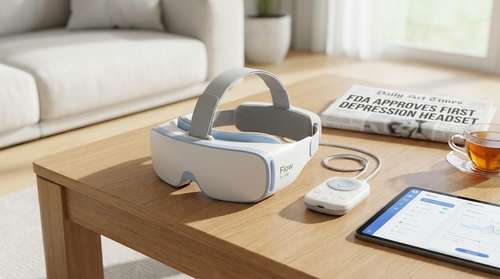
In a historic move for mental health treatment, the FDA has officially cleared the Flow FL-100, marking the first time a transcranial direct current stimulation (tDCS) device has been approved for at-home use to treat major depression. This groundbreaking regulatory decision, finalized in late 2025 and making headlines now in early 2026, signals a paradigm shift toward accessible, non-drug depression therapies. For the nearly 48 million Americans battling Major Depressive Disorder (MDD), this wearable headset offers a new lifeline—one that can be used from the comfort of a living room rather than a clinic.
A New Era of At-Home Brain Stimulation
The approval of the Flow FL-100 at-home treatment represents a significant leap forward in psychiatric care. Developed by Swedish med-tech company Flow Neuroscience, the device uses low-level electrical signals to stimulate the brain, a technique known as tDCS. Unlike traditional neurostimulation therapies like TMS (Transcranial Magnetic Stimulation), which require daily visits to a specialized clinic, the Flow headset is designed for patient self-administration.
"This is widely considered the beginning of 'electric medicine' for the mass market," says industry analyst Dr. Sarah Jenkins. "By moving effective neuromodulation out of the hospital and into the home, we are removing massive barriers to care, including cost, stigma, and scheduling logistics."
The device targets the dorsolateral prefrontal cortex, a region of the brain often showing reduced activity in people with depression. By delivering a gentle electrical current, the headset aims to rebalance neural activity and alleviate depressive symptoms. The treatment is paired with a behavior therapy app, ensuring a holistic approach that combines biological stimulation with psychological support.
Clinical Breakthroughs: 58% Remission Rate
The FDA's decision was heavily influenced by the results of the pivotal Empower Phase 2 study. The data revealed that the Flow FL-100 is not just safe, but highly effective. In the 10-week trial, 58% of participants achieved full remission, a success rate that rivals and, in some cases, exceeds that of standard antidepressants. Furthermore, 77% of real-world users in Europe reported symptom improvement within just three weeks.
Crucially, the side effect profile is minimal compared to systemic medications. While antidepressants often come with risks of weight gain, sexual dysfunction, or insomnia, the at-home brain stimulation device primarily causes mild skin irritation or headaches that typically resolve quickly. This makes it an attractive option for the millions of patients who either do not respond to pharmaceuticals or cannot tolerate their side effects.
Who Is It For?
The FDA has cleared the device for adults aged 18 and older with moderate to severe major depressive disorder. Uniquely, it can be prescribed as a standalone monotherapy or used alongside existing medication regimens. Unlike some other neurostimulation approvals that are reserved for "treatment-resistant" patients, the Flow FL-100 is available as a first-line option, broadening its potential impact significantly.
Market Launch and Accessibility
With the approval secured, Flow Neuroscience has announced a U.S. commercial launch slated for Q2 2026. The FDA approved depression headset will be available by prescription only. Patients will need to consult with a healthcare provider, who can then prescribe the device to be shipped directly to the patient's home.
Regarding cost, the company is targeting a price point between $500 and $800. While reimbursement discussions with major insurers are ongoing, the cost is a fraction of the $10,000+ price tag often associated with in-clinic TMS courses. This affordability is a key driver in the push for new depression treatments 2026, democratizing access to advanced mental health technology.
The 2026 Neurotech Boom: Neurolief and Beyond
The Flow FL-100 isn't the only player reshaping the landscape. Just weeks after Flow's milestone, the FDA also granted approval to the Neurolief ProlivRx system in January 2026. While Flow uses tDCS, Neurolief's device employs a different technology called Combined Occipital and Trigeminal Afferent Stimulation (eCOT-AS). The Neurolief ProlivRx FDA approval is specifically targeted as an adjunctive therapy for patients who have failed at least one antidepressant.
Together, these approvals underscore a massive trend in non-drug depression therapies 2026. The mental health field is rapidly moving away from a "pills-only" model toward a diverse ecosystem of bioelectronic and digital therapeutics. Physicians now have a toolkit that allows for personalized treatment plans, combining biological interventions with digital monitoring.
What This Means for Patients
For patients, the arrival of transcranial direct current stimulation for depression in a home setting offers autonomy. Treatment typically involves wearing the headset for 30 minutes a day for the first few weeks, followed by a maintenance schedule. This routine can be easily integrated into daily life, whether while reading, watching TV, or working.
As we move further into 2026, the stigma around using technology for mental health is fading. The Flow FL-100 is more than just a gadget; it is a validated medical device that promises to bring relief to millions who have been waiting for a better way to heal.