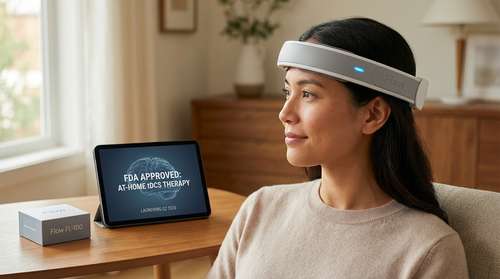
In a watershed moment for mental health treatment in the United States, the Food and Drug Administration (FDA) has officially approved the Flow FL-100, the first-ever medical-grade brain stimulation headset designed for at-home use. Confirmed in new regulatory updates this week, this historic decision marks a paradigm shift for the millions of Americans battling moderate to severe major depressive disorder (MDD). With a planned US commercial launch in Q2 2026, this non-invasive technology offers a drug-free lifeline to patients who have struggled with traditional antidepressants.
A New Era: FDA Approved Depression Headset Explained
The Flow FL-100 represents a significant technological leap in psychiatric care. Unlike traditional transcranial magnetic stimulation (TMS), which requires bulky equipment and frequent clinic visits, the FL-100 utilizes transcranial direct current stimulation (tDCS). This compact, wireless headset delivers a gentle, low-level electrical current to the dorsolateral prefrontal cortex—a specific region of the brain often underactive in people with depression.
By stimulating this area, the device helps restore neural activity and improve mood regulation. "We aren't just launching a product; we are validating a new category of care that is accessible, personal, and profoundly effective," said Erin Lee, CEO of Flow Neuroscience. The device is paired with a comprehensive behavioral therapy app, guiding users through lifestyle changes that support mental well-being alongside the stimulation therapy.
Breaking Down the Science: Efficacy and Results
The FDA's approval—specifically a Class III Premarket Approval (PMA)—was based on data from the pivotal "Empower" clinical trial. The results, which have generated significant buzz in the medical community this January, demonstrated that the Flow FL-100 at-home treatment is highly effective. In the 10-week randomized controlled trial, 58% of participants achieved remission, meaning their depression symptoms virtually disappeared.
Key Clinical Findings
- High Remission Rate: The 58% remission rate is comparable to, and in some cases exceeds, that of standard antidepressant medications.
- Rapid Relief: Many users in real-world European cohorts reported symptom improvement in as little as three weeks.
- Safety Profile: The treatment showed minimal side effects, avoiding common medication issues like weight gain, insomnia, or sexual dysfunction. Reported side effects were mostly mild skin irritation at the electrode site.
How the Flow FL-100 Treatment Works
For patients, the treatment process is designed to be seamless and user-friendly. The brain stimulation technology is self-administered at home, typically involving five 30-minute sessions per week for the first three weeks, followed by a maintenance schedule of three sessions per week. Users wear the headset while performing simple daily tasks or relaxing.
Crucially, while the device is used at home, it remains a prescription-only treatment. Patients will need a prescription from a healthcare provider, ensuring that this non-drug depression therapy is integrated safely into their broader care plan. The companion app also allows clinicians to monitor progress remotely, bridging the gap between clinical oversight and patient independence.
Cost, Access, and the 2026 US Launch
With the official Flow Neuroscience US launch set for the second quarter of 2026, attention has turned to accessibility. Flow Neuroscience has announced a target price range of $500 to $800 for the device. This pricing strategy positions the FL-100 as a significantly more affordable alternative to in-clinic TMS therapy, which can cost upwards of $10,000 per course.
The company is currently finalizing distribution partnerships and working with insurers to establish reimbursement pathways. Given the economic burden of depression—projected to cost the US economy nearly $540 billion by 2030—payers are showing early interest in this cost-effective, scalable intervention.
Why This Matters for Mental Health in 2026
The approval comes at a critical time. Approximately 21 million American adults suffer from major depression, and nearly one-third do not find relief with standard medications. For these patients, the tDCS for depression 2026 breakthrough offers new hope. By moving effective neuromodulation out of the clinic and into the living room, the FDA and Flow Neuroscience are dismantling barriers to care, including long wait times, geographical distance from specialists, and the stigma often associated with mental health treatment.
As we approach the Q2 launch, the Flow FL-100 stands as a testament to the power of at-home mental health devices to transform lives, proving that effective, clinical-grade treatment can happen on the patient's terms.