The landscape of mental health care is shifting rapidly, driven by the urgent need for safer and more effective interventions for young people. For years, clinicians have struggled to manage the escalating crisis of youth mental illness using conventional medications that often fall short or carry heavy side effects. Now, an adolescent mental health breakthrough is fundamentally changing the conversation. According to a landmark study published in BMC Psychiatry on April 9, 2026, a novel approach known as Deep Intracranial Frequency Stimulation (DIFS) is demonstrating profound success in alleviating major depression and non-suicidal self-injury (NSSI) in female teenagers.
This pediatric psychiatry news represents a pivotal moment for treatment-resistant patients. By delivering precise, high-gamma electrical currents to specific neural networks, this non-invasive brain stimulation provides rapid relief without relying on pharmaceutical interventions. For families navigating the frightening realities of severe mood disorders and self-injurious behaviors, this technology offers a promising new horizon.
The Urgent Need for Better Teen Depression Treatments in 2026
Major Depressive Disorder (MDD) among adolescents has reached critical levels globally, complicated by rising rates of self-harm and suicidal ideation. Traditional treatment paradigms typically lean heavily on selective serotonin reuptake inhibitors (SSRIs) and talk therapy. While these methods are effective for some, a significant percentage of teens are classified as treatment-resistant, meaning their symptoms persist despite multiple therapeutic attempts.
Furthermore, standard psychiatric medications come with a litany of potential side effects, ranging from emotional blunting and severe weight gain to the paradoxical worsening of suicidal thoughts in pediatric populations. The psychiatric community has long been searching for a physiological intervention that directly addresses the neurological roots of depression without systemic chemical side effects. The latest teen depression treatments 2026 are prioritizing non-systemic interventions, and DIFS is currently leading the charge in clinical efficacy.
A Closer Look at the DIFS Therapy for Depression
Unlike older neurostimulation methods that primarily target the brain's superficial cortical layers, Deep Intracranial Frequency Stimulation penetrates deeper into the midbrain structures. Developed by Nexalin Technology, the treatment utilizes a specialized 77.5 Hz, 15 mA high-gamma approach. This specific alternating current frequency is deliberately calibrated to engage and stabilize the emotional-control networks that govern mood regulation, rumination, and impulse control.
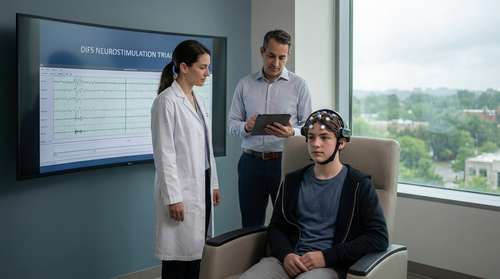
During the clinical trial, participants underwent a comprehensive 21-day regimen using the Nexalin DIFS device. Because the procedure is non-invasive, patients remain completely awake, alert, and comfortable throughout the sessions. The safety profile is remarkably clean; researchers observed no significant adverse systemic effects, with only a single participant reporting a mild, quickly resolving headache. In an era demanding safer alternatives, a drug-free DIFS therapy for depression that avoids physical dependence and cognitive dampening is incredibly appealing to both psychiatrists and parents.
Measurable Reductions in Self-Harm and Depressive Symptoms
The core objective of the BMC Psychiatry pilot study was to evaluate the intervention's impact on highly vulnerable female adolescents engaging in non-suicidal self-injury. The therapeutic outcomes were statistically striking. Following the three-week stimulation protocol, participants showed drastic, quantifiable improvements on the Hamilton Depression Rating Scale (HAMD-24). In fact, every single participant in the cohort met the predefined clinical response criterion for severe depression.
Beyond mood enhancement, the treatment operated as a highly effective self-harm prevention technology. Using the Ottawa Self-Injury Inventory, researchers documented a significant decrease in both self-injurious thoughts and physical behaviors. Five out of the six adolescents in the group-an impressive 83.3%-met the response criteria for self-injury reduction. These clinical benefits, which notably included better sleep quality and reduced general anxiety, persisted well through the post-treatment follow-up period.
Objective Evidence Through Advanced Neuroimaging
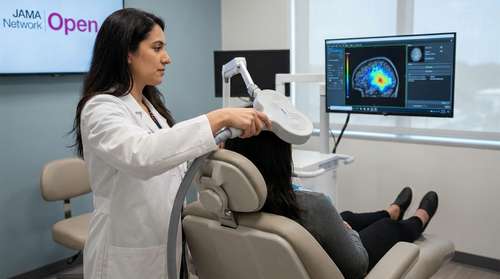
Subjective symptom reporting is crucial, but it is only one piece of the clinical puzzle. What truly elevates this study is the objective neurophysiological data backing the symptomatic improvements. Investigators utilized Transcranial Magnetic Stimulation combined with Electroencephalography (TMS-EEG) to map and monitor real-time changes in the brain's architecture. The sophisticated neuroimaging revealed measurable functional connectivity changes across several vital regions: the default mode, limbic, salience/ventral attention, and executive control networks.
This reveals a profound mechanism of action: the therapy isn't just temporarily masking distress; it appears to be actively rewiring and regulating the dysregulated neural circuits responsible for rumination and self-harm. This hard physiological evidence validates the underlying mechanisms of DIFS and bolsters its standing as a scientifically rigorous intervention.
The Future of Adolescent Mental Health Breakthroughs
While the initial data is overwhelmingly positive, researchers and the device developers classify these findings as preliminary evidence. The next crucial step in validating this self-harm prevention technology involves launching larger, randomized, placebo-controlled trials to further establish efficacy across a broader, more diverse demographic. However, the successful modulation of deep brain structures without surgical implants or chemical dependency marks an undeniable victory for the field.
As we look at the evolution of psychiatric care, non-invasive therapies are rapidly shifting from experimental alternatives to essential, frontline considerations. For young patients who have exhausted traditional cognitive behavioral therapy and SSRI prescriptions, the emergence of Deep Intracranial Frequency Stimulation offers genuine, evidence-based hope. If larger trials mirror these early, promising successes, this breakthrough could soon become a standard clinical pillar in the fight against adolescent depression, fundamentally reshaping how the medical community protects its most vulnerable patients.