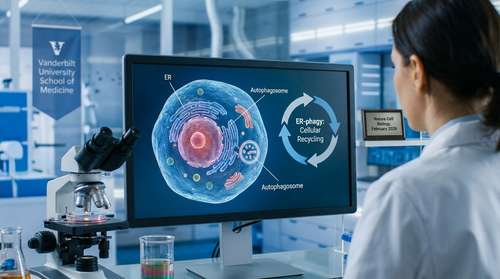
A groundbreaking study from Vanderbilt University has reshaped our understanding of how we age, identifying a hidden cellular process that acts as an early trigger for biological decline. Published in Nature Cell Biology in February 2026, the research reveals that cells do not simply wear out over time; instead, they actively dismantle their own protein-producing architecture through a mechanism known as ER-phagy. This discovery offers a new paradigm for longevity research, suggesting that interventions targeting this specific remodeling process could potentially halt the onset of age-related diseases long before symptoms appear.
The Silent Demolition Inside Your Cells
For decades, scientists viewed aging as a passive process of accumulation—damage building up like rust on a car. However, the team led by Kris Burkewitz, Assistant Professor of Cell and Developmental Biology at Vanderbilt, has found evidence that aging is partly a programmed renovation. The study focuses on the endoplasmic reticulum (ER), a massive organelle often described as the cell's factory. The ER is responsible for synthesizing proteins (via the "rough" ER) and lipids (via the "smooth" ER).
The researchers discovered that as cells age, they initiate a "controlled demolition" of the rough ER. Using advanced genetic tools and microscopy on C. elegans, a model organism for aging, they observed cells stripping away the protein-producing regions of the ER while leaving the fat-producing regions relatively intact. This dramatic ER-phagy aging discovery suggests that cells deliberately shift their metabolic focus away from protein maintenance as they get older, a change that may predispose the organism to later dysfunction.
ER-Phagy: The Mechanism of Cellular Remodeling
The engine driving this architectural change is ER-phagy, a selective form of autophagy (self-eating). While autophagy is generally considered a beneficial housekeeping process that cleans up cellular debris, this specific variation targets the cellular infrastructure itself. The Vanderbilt team found that this remodeling occurs surprisingly early in the life cycle, acting as a potential "first domino" in the cascade of aging.
"Changes in the ER occur relatively early in the aging process," Burkewitz explained in the study. "One of the most exciting implications of this is that it may be one of the early triggers of aging leading to downstream dysfunction and disease."
By identifying the specific genetic pathways that control this demolition, the researchers have pinpointed a targetable mechanism. Unlike general cellular damage, which is random, this cellular remodeling longevity pathway is specific and regulated, meaning it could theoretically be tuned or reversed with future therapeutics.
Implications for Human Healthspan Extension
The link between this cellular process and longevity is complex and fascinating. When the researchers blocked the ER-phagy process in long-lived worms, the animals lost their longevity advantage. This indicates that while the loss of protein-producing capacity marks the start of aging, the process itself might be an adaptive response—a way for the cell to conserve energy or prevent the accumulation of misfolded proteins.
However, this adaptation comes at a steep cost. By downscaling the factory early, the cell limits its ability to repair and maintain itself later in life. This trade-off is central to the quest for human healthspan extension. If scientists can learn to maintain the ER's protein-producing capacity without triggering the stress responses that necessitate its removal, they might be able to delay the fundamental onset of frailty.
Vanderbilt University's Role in Healthy Aging Research
This study highlights Vanderbilt University healthy aging research as a leader in the field of geroscience. The collaboration, which included researchers Eric Donahue and Jason MacGurn, moves the field beyond simple "anti-aging" concepts toward a sophisticated engineering approach. By mapping the spatial reorganization of organelles, they are defining the physical changes that separate a young cell from an old one.
The findings published in Nature Cell Biology February 2026 provide a concrete blueprint for the next generation of longevity drugs. Instead of just trying to clean up damage, future therapies might focus on preventing the "renovation" that shuts down the cell's essential machinery.
Can We Reverse Cellular Aging?
The ultimate question remains: can we reverse cellular aging by halting ER-phagy? While we are not yet at the stage of clinical trials for humans, the identification of this pathway is a critical step forward. It suggests that the functional decline associated with aging is not inevitable but is, at least in part, a decision made by our cells. Understanding why the cell decides to downsize its factory is the next frontier.
As research progresses, the focus will shift to finding molecules that can modulate ER-phagy in human tissues. If successful, this could lead to treatments that keep our cellular factories running at full capacity well into our later years, fundamentally changing the trajectory of human health.