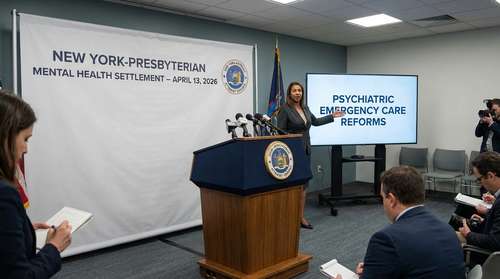
On April 13, 2026, New York Attorney General Letitia James announced a groundbreaking New York-Presbyterian mental health settlement that will radically transform how one of the state's largest healthcare systems handles psychiatric emergencies. Following a rigorous, years-long investigation, state officials determined that the hospital repeatedly failed to properly evaluate, stabilize, and supervise patients experiencing extreme distress. The sweeping agreement imposes a $500,000 penalty and mandates immediate, comprehensive reforms to emergency department procedures, patient monitoring, and inpatient bed availability.
Exposing the Failures in Emergency Department Psychiatric Care
The New York Office of the Attorney General (OAG) uncovered a disturbing pattern of systemic negligence regarding emergency department psychiatric care. The investigation was launched following mounting concerns and testimonies from medical providers, mental health advocates, and impacted families regarding dangerous gaps in services. Investigators meticulously reviewed data from thousands of behavioral health emergency visits, incident reporting systems, and patient records to build the state's case.
They found that patients presenting with severe psychiatric symptoms were routinely met with inadequate supervision. Due to massive gaps in safety protocols, highly vulnerable individuals were frequently allowed to walk out of the hospital before being properly discharged or transferred to appropriate inpatient facilities. These severe oversights put both the struggling individuals and the general public at serious risk.
Ignoring the Crisis: Unused Beds and Ambulance Diversions
Furthermore, during a period of escalating demand for behavioral health services, the healthcare system intentionally kept critical inpatient capacity offline. Despite clear directives from state regulators to restore services as the COVID-19 pandemic subsided, New York-Presbyterian left over 100 licensed psychiatric beds out of operation as of May 2023. The investigation also revealed that the hospital frequently diverted ambulances carrying mental health patients away from their emergency departments without any formal or defined policy in place.
When hospitals fail to uphold basic hospital patient safety 2026 standards, patients in acute distress are denied their fundamental rights to medical care. The Letitia James settlement addresses these massive care gaps directly. As Attorney General James emphasized during the April 13 announcement, hospitals possess both a legal and moral obligation to treat mental health crises with the exact same urgency and compassion as physical medical emergencies.
Sweeping Psychiatric Emergency Care Reforms Mandated
To rectify these historic failures, the New York-Presbyterian mental health settlement forces the healthcare giant to implement a completely restructured behavioral health framework. This legally binding agreement represents one of the most comprehensive psychiatric emergency care reforms in recent state history.
The hospital system is now required to immediately correct its bed shortage. Under the terms of the settlement, the Westchester Behavioral Health facility must explicitly add two inpatient psychiatric beds to hit a fully operational capacity of 235 licensed beds by December 2026. However, restoring physical beds is only one facet of the required overhaul. The state is demanding stringent operational changes to ensure that no patient slips through the cracks upon entering the emergency room doors.
Upgrading Suicide Risk Screening Protocols
At the clinical level, the settlement forces New York-Presbyterian to vastly improve its intake and observation methods. Medical staff must now utilize enhanced suicide risk screening protocols to rapidly identify critical dangers such as self-harm, violence, and substance use.
Under the new state mandates, hospital administrators must strictly enforce:
- Mandatory, documented follow-up assessments for anyone identified as high-risk upon admission.
- Strict continuous observation protocols ensuring vulnerable patients cannot leave the facility unsupervised.
- Comprehensive monitoring logs tracking all clinical decisions and patient movements.
- Ongoing, standardized reassessments for individuals waiting for extended periods in the emergency department.
The introduction of these rigid screening and observation rules effectively removes the dangerous ambiguity that previously plagued the hospital's evaluations. By forcing providers to maintain meticulous, real-time documentation, the settlement ensures that clinical staff cannot bypass essential safety checks simply due to overcrowding or understaffing.
Enforcing Stronger Mental Health Patient Rights
Accountability remains the cornerstone of the state's intervention. While the initial $500,000 fine covers investigative fees and misconduct penalties, the ongoing financial threat is designed to ensure permanent operational compliance. The Attorney General's office secured a stipulation imposing an automatic $10,000 penalty for every single future violation of the settlement terms.
This massive financial liability transforms mental health patient rights from a theoretical concept into a strictly enforced reality. Hospital administrators must now treat psychiatric compliance with the highest degree of administrative scrutiny. State regulators will monitor New York-Presbyterian closely to ensure appropriate planning, transparency, and full adherence to all laws governing psychiatric bed capacity going forward.
The decisive action taken against New York-Presbyterian serves as a powerful warning to healthcare systems nationwide. As emergency rooms increasingly serve as the primary entry point for behavioral health treatment, failing to secure, stabilize, and properly treat psychiatric patients carries unprecedented legal consequences. The mandatory protocols born out of this historic investigation set a new, vital benchmark for hospital patient safety 2026, signaling that inadequate care will no longer be tolerated in New York.