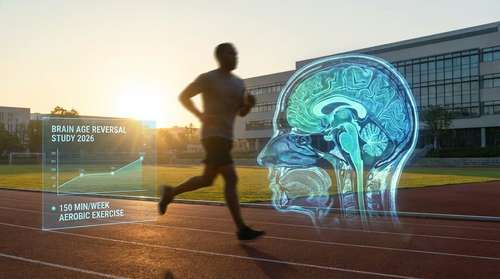
A landmark study published on January 22, 2026, has confirmed what neuroscientists have long suspected: you can turn back the clock on your brain. The research, released in the Journal of Sport and Health Science, reveals that adults who commit to a consistent aerobic exercise routine for just one year can reverse biological brain aging by nearly a full year. This breakthrough adds definitive proof to the link between cardiovascular fitness and cognitive longevity, offering a clear roadmap for protecting brain health during the critical midlife years.
The One-Year Reversal: Key Findings
Conducted by researchers at the AdventHealth Research Institute, this randomized clinical trial followed 130 healthy adults between the ages of 26 and 58. Participants were divided into two groups: one that maintained their usual lifestyle and another that adhered to a structured aerobic exercise program. The active group targeted 150 minutes of moderate-to-vigorous physical activity per week, a standard recommendation by the American College of Sports Medicine.
After 12 months, MRI scans told a powerful story. While the control group’s brains showed typical signs of aging—appearing approximately 0.35 years older—the exercise group’s brains actually looked 0.60 years younger biologically. When compared directly, the exercisers held a nearly one-year advantage in brain health over their sedentary peers. Dr. Lu Wan, the study’s lead author, noted that while these changes might seem modest, they represent a significant shift in the trajectory of brain aging that could compound over decades.
Understanding 'Brain Age' and MRI Technology
To measure these changes, scientists used a cutting-edge metric called Brain-Predicted Age Difference (brain-PAD). This biomarker uses machine learning algorithms to analyze structural MRI data, comparing a person's chronological age with how old their brain appears anatomically. A higher brain-PAD indicates accelerated aging, which is often a precursor to cognitive decline and dementia.
The study found that increasing cardiorespiratory fitness (measured by VO2peak) correlated with a younger-looking brain. Interestingly, the research team discovered that improved fitness alone didn't fully account for the brain age reversal. This suggests that aerobic exercise triggers a complex cascade of neuroprotective benefits—likely involving increased blood flow, reduced inflammation, and the release of growth factors like BDNF (Brain-Derived Neurotrophic Factor)—that work together to preserve grey matter volume.
Why Midlife is the Critical Window
One of the most compelling aspects of this 2026 study is its focus on adults aged 26 to 58. Historically, much of the research on exercise and dementia has focused on seniors who are already showing signs of decline. By shifting the focus to early and mid-adulthood, researchers have identified a crucial window of opportunity.
Dr. Kirk I. Erickson, a senior author on the study, emphasized that waiting until old age to prioritize brain health may be too late. The structural decay associated with Alzheimer’s and other forms of dementia often begins 15 to 20 years before symptoms appear. This new data proves that interventions in your 30s, 40s, and 50s can effectively "bank" brain reserve, potentially delaying the onset of neurodegenerative diseases.
Your Action Plan: 150 Minutes to a Younger Brain
The prescription for a younger brain is accessible and achievable. The study participants didn't run marathons; they simply met the standard guideline of 150 minutes of aerobic activity per week. This breaks down to roughly 30 minutes a day, five days a week.
- Brisk Walking: A pace where you can talk but not sing.
- Cycling: Moderate effort on a stationary or outdoor bike.
- Swimming: Continuous laps that elevate your heart rate.
- Group Classes: Dance cardio or aerobics that keep you moving.
Consistency is the key variable. The brain age reversal observed in the study was the result of steady, year-long adherence to this routine. Start today, and by this time next year, your brain could be biologically younger than it is right now.