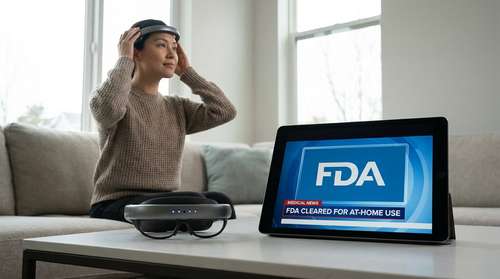
For decades, treating severe depression has largely meant navigating a maze of pharmaceutical trials or committing to time-intensive, in-clinic therapies. But in a landmark decision this week, regulators have rewritten the psychiatric playbook. The FDA has officially cleared the first prescription at-home brain stimulation devices for Major Depressive Disorder (MDD), marking a radical shift in psychiatric care,. These wearable headsets allow patients to safely self-administer clinical-grade neuromodulation from their own living rooms, fundamentally democratizing access to mental health treatment.
The Dawn of Electric Medicine for Mental Health
Psychiatrists have long understood that depression is as much an electrical problem as a chemical one. While traditional selective serotonin reuptake inhibitors (SSRIs) flood the brain with neurotransmitters, they do not work for everyone and often come with debilitating side effects. The recent Flow Neuroscience FDA approval, alongside the clearance of Neurolief's ProlivRx system, introduces a scalable alternative. Psychiatrists are calling this paradigm shift the rise of electric medicine for mental health.
Rather than relying solely on systemic drugs, these devices deliver targeted, low-intensity electrical currents to specific neural pathways associated with mood regulation. With over 47 million American adults struggling with MDD in 2026, the demand for non-pharmacological interventions has never been higher. By moving these treatments out of specialized clinics and into the home, patients no longer have to endure months-long waitlists or travel distances to receive advanced care.
How the Flow FL-100 and ProlivRx Depression Headset Work
While both newly cleared devices fall under the umbrella of at-home brain stimulation, they utilize distinct technologies to achieve remission. The Flow FL-100 relies on transcranial direct current stimulation (tDCS). Patients wear a sleek headset that directs a gentle electrical current to the left dorsolateral prefrontal cortex—a brain region that typically shows diminished activity in depressed individuals,. By stimulating these neurons, the device effectively wakes up the area responsible for mood and emotional control.
Conversely, the ProlivRx depression headset employs external Combined Occipital and Trigeminal Afferent Stimulation (eCOT-AS). Instead of targeting the cortex directly, this FDA approved depression device sends mild pulses to specific nerve branches located on the scalp. These nerves act as superhighways, carrying the electrical signals deep into the brainstem to rebalance the neural circuits misfiring due to depression.
Targeting Treatment-Resistant Depression 2026
The clinical application of these two devices highlights a nuanced approach to neuromodulation for MDD. The Flow FL-100 is indicated for adults with moderate to severe depression and can be used as a frontline monotherapy or alongside existing medications. However, for patients facing treatment-resistant depression 2026 offers the ProlivRx system. The FDA specifically cleared ProlivRx as an adjunctive treatment for individuals who have had an inadequate response to at least one prior antidepressant medication,, offering a critical lifeline when standard pills fail.
Shifting from Clinic to Living Room: Why This Matters
Historically, patients seeking neuromodulation for MDD had to rely on Transcranial Magnetic Stimulation (TMS) or Electroconvulsive Therapy (ECT). While highly effective, these options require daily clinic visits for weeks on end and can cost thousands of dollars per treatment course. The approval of an at-home brain stimulation device shatters this geographical and financial barrier.
Under the new regulatory framework, a licensed clinician prescribes the headset and monitors the patient's progress remotely via a synchronized smartphone application,. Patients typically use the device for 30 to 40 minutes a day, three to five times a week, while reading, working, or simply having their morning coffee. It provides the rigorous oversight of a medical professional with the unparalleled convenience of a consumer health wearable.
Clinical Results: Efficacy and Side Effects
The data backing this new electric medicine for mental health is robust. In the Empower clinical trial, which supported the Flow Neuroscience FDA approval, an impressive 58% of patients achieved clinical remission within 10 weeks of use,. Similarly, the MOOD trial for the ProlivRx depression headset demonstrated significantly higher remission rates compared to a sham treatment, with patients experiencing rapid, clinically meaningful improvements in their baseline mood.
Since the electrical current bypasses the digestive system and bloodstream, systemic side effects like weight gain, insomnia, or sexual dysfunction are virtually eliminated. The most commonly reported adverse effects are mild and transient, including temporary scalp tingling, slight redness at the electrode site, or occasional mild headaches,.
As these devices begin their nationwide rollout this week, the mental health landscape is standing on the precipice of a major transformation. For millions of Americans exhausted by the trial-and-error cycle of traditional antidepressants, the future of depression care is no longer found solely in a pill bottle. It might just be an FDA approved depression device resting on your nightstand.