For decades, humanity's quest for eternal youth has been defined by superficial fixes, ranging from costly serums to invasive cosmetic procedures. However, the true frontier of longevity lies deep within our cellular biology. In what is rapidly becoming one of the most heavily discussed longevity breakthroughs 2026 has seen, researchers in Japan have successfully identified a biological master switch. The discovery centers around AP2A1 protein aging mechanisms, proving that suppressing this specific molecule can physically reset aged cells to a youthful state.
Unmasking the Architecture of Cellular Senescence
To fully grasp the magnitude of this anti-aging protein discovery, you first have to look at how our bodies degrade at a microscopic level. As we grow older, many of our cells sustain DNA damage and eventually stop dividing. Instead of dying off and making way for new tissue, they enter a dormant, toxic state called senescence. Biologists frequently refer to these as "zombie cells." They linger in tissues across the body, pumping out inflammatory signals that accelerate tissue degradation and drive age-related diseases like Alzheimer's, osteoarthritis, and cardiovascular failure.
Scientists at Osaka University, led by researchers Pirawan Chantachotikul and Shinji Deguchi, noticed a distinct physical anomaly in these senescent cells: they are massively enlarged and packed with thick structural cables known as stress fibers. Through rigorous proteomic analysis, the team discovered that the Adaptor Protein Complex 2, Alpha 1 Subunit (AP2A1) accumulates heavily along these internal fibers as the cell ages.
The Role of Integrin β1
The research revealed that AP2A1 doesn't act alone. It tightly associates with another protein called integrin β1, which acts like an anchor. Together, they bind the aging cell firmly to its surrounding extracellular matrix. This hyper-adhesion locks the zombie cell into its bloated, dysfunctional structure, preventing the tissue from healing or clearing out the cellular debris.
Flipping the Switch: Cellular Rejuvenation Research
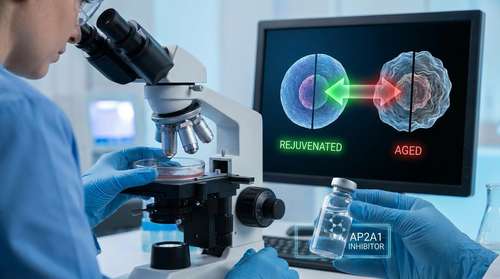
Identifying the structural glue of a decaying cell is an impressive biological feat, but dismantling it is where the real medical potential lies. In a series of groundbreaking laboratory experiments published in Cellular Signalling, the Japanese research team utilized silencing RNA (siRNA) to turn off the production of AP2A1 in aged human fibroblasts. The outcomes immediately shifted the landscape of cellular rejuvenation research.
By simply suppressing this single protein, the researchers forced the dormant, oversized zombie cells to shrink back to a normal, youthful size. More importantly, the cells resumed their standard division cycles. Classic biological markers intrinsically linked to aging, including the p53 and p21 pathways, saw dramatic reductions. By manipulating AP2A1 expression, scientists didn't just stall the aging clock—they managed to reverse biological aging entirely within the controlled laboratory models.
To confirm the protein was the actual driver of senescence and not just a byproduct, the team performed the experiment in reverse. When they artificially overexpressed AP2A1 levels in healthy, young cells, those cells rapidly aged. They developed the exact same thickened stress fibers and enlarged, toxic structures typically seen only in older tissues.
A New Era for Healthspan Extension
The implications of this study stretch far beyond the vanity of cosmetic anti-aging. The modern medical community is intensely focused on healthspan extension—maximizing the decades we live completely free from chronic illness, rather than just prolonging a frail existence. Because senescent cells are the root cause of chronic, systemic inflammation, clearing them or reverting them to a functional state could mitigate the onset of age-related physical and cognitive decline.
Recent developments in early 2026 point to highly effective combinatorial therapies. Laboratory tests have paired AP2A1 suppression with compounds like IU1, a molecule designed to help cells sweep away damaged internal proteins. When applied together, the regenerative effects compounded significantly. Cells underwent a deep molecular cleaning, resetting their biological clocks and establishing a pristine environment for new cellular growth. This dual-action approach is now fueling intense discussions among pharmacologists regarding the logistics and safety of near-term human clinical trials.
The Future of Healthy Aging News
Transitioning from isolated human cells in a petri dish to a living, breathing organism presents undeniable hurdles. AP2A1 is a fundamental building block for general cellular transport. Systemic suppression in a living human requires pinpoint accuracy to avoid dangerous side effects. Biologists will need to develop highly targeted delivery methods that only silence the protein inside specific senescent tissues while leaving healthy, young cells entirely undisturbed.
Despite the long road ahead, the identification of the AP2A1 mechanism remains a watershed moment for regenerative medicine. Keeping up with healthy aging news often means sorting through exaggerated claims, influencer-backed supplements, and speculative science. This peer-reviewed breakthrough cuts through the noise, providing a concrete biological target for therapies that could fundamentally alter the human experience. If the next phase of animal and human trials proves successful, flipping the biological switch on aging will transition from science fiction into clinical reality.