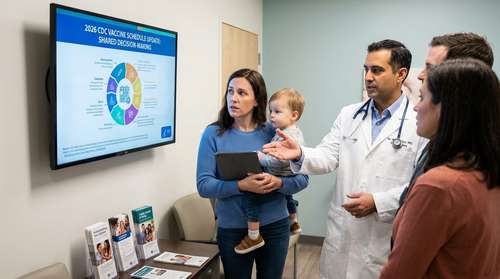
Washington, D.C. — As American families navigate the heart of the winter respiratory virus season this week, a profound confusion has gripped pediatric healthcare. Following the Centers for Disease Control and Prevention's (CDC) historic January overhaul of the childhood immunization schedule, parents are facing an unprecedented "shared decision" dilemma that has intensified in the last 48 hours. The shift, which moved vaccines for influenza, COVID-19, and meningitis from "universally recommended" to a "shared clinical decision-making" model, has created a fractured landscape where federal guidance directly contradicts the advice of the American Academy of Pediatrics (AAP) and state health departments.
The End of the Universal Mandate
The controversy centers on the CDC’s massive reduction of routinely recommended vaccines from 17 down to 11, a move orchestrated by HHS Secretary Robert F. Kennedy Jr. to align the U.S. schedule with "peer nations" like Denmark. As of February 2026, the vaccines for influenza, COVID-19, Hepatitis A, Hepatitis B, and Meningococcal disease are no longer automatically recommended for all healthy children. Instead, they fall under "shared clinical decision-making" (SCDM).
Under this new framework, pediatricians are not supposed to routinely administer these shots but rather discuss them with parents to decide if the individual risk warrants vaccination. "The term 'shared decision-making' sounds empowering, but in practice, it’s creating paralysis," says Dr. Elena Rodriguez, a pediatrician in Northern Virginia. "Parents are asking if these diseases have suddenly become less dangerous. The answer is no, but the federal guidance suggests otherwise."
States vs. Feds: A Widening Divide
The panic has been exacerbated this week as the divide between state and federal authorities reached a breaking point. As of today, 27 states have formally announced they will reject the new CDC 2026 childhood vaccine schedule, choosing instead to adhere to the AAP’s guidelines, which maintain universal recommendations for all 17 previously covered diseases.
This bureaucratic tug-of-war has left families in a "medical no-man's-land." In states like California and New York, schools are maintaining strict vaccine mandates based on the old schedule, while in Florida and Texas, the new federal guidance is being cited to challenge those very mandates. "I don't know who to listen to," admits Sarah Jenkins, a mother of two in Ohio. "My doctor says one thing, the CDC website says another, and my school board is holding emergency meetings. It’s terrifying."
The Insurance Coverage Confusion
Adding to the anxiety is the looming question of cost. While CMS Administrator Dr. Mehmet Oz has assured the public that the Affordable Care Act (ACA) will continue to cover these vaccines without cost-sharing, reports have surfaced in the last two days of insurance denials for "non-routine" vaccinations. Because the CDC no longer classifies these shots as "routine" for all children, some smaller insurance plans are exploiting the loophole, leaving parents fearing unexpected bills for vaccines that were free just months ago.
Shared Clinical Decision-Making: Feature or Bug?
The shift to SCDM was marketed as a way to reduce "coercion" and respect parental rights. However, critics argue it effectively dismantles the concept of herd immunity. By treating vaccines for contagious respiratory viruses as optional "lifestyle" choices rather than public health necessities, the new schedule places the burden of epidemiological analysis on individual families.
Public health experts warn that this specific week in February—typically a peak time for flu and meningococcal transmission—is the worst possible moment for mixed messaging. "We are seeing a drop in flu vaccine uptake of nearly 40% compared to last year," notes a report released yesterday by the Association of State and Territorial Health Officials. "When you make a vaccine a 'discussion' rather than a 'standard,' participation plummets."
What Parents Need to Do Now
For families caught in this 2026 vaccine schedule chaos, experts recommend three immediate steps:
- Consult Your Pediatrician: Most board-certified pediatricians are following the AAP schedule, not the new CDC reduced list.
- Check School Requirements: State laws supersede federal CDC recommendations. Most public school mandates remain unchanged for now.
- Verify Insurance: Call your provider to confirm that "shared decision" vaccines are coded as preventive care to avoid copays.
As the standoff continues, the "Shared Decision" dilemma serves as a stark reminder of how quickly established public health norms can be upended, leaving American families to navigate the fallout.