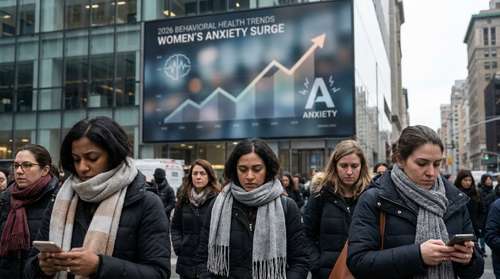
The United States is facing a compounding healthcare crisis that has grown undeniably severe since the onset of the pandemic. Released just this week, the highly anticipated 2026 behavioral health report by Trilliant Health exposes a staggering reality: a 62.6% spike in mental health service utilization since 2018. While the exhaustive data points to systemic distress across nearly every demographic, the most striking finding centers on an unprecedented anxiety surge in women.
Unpacking the Mental Health Demand Surge
According to the latest Trilliant Health 2026 report, psychological care is no longer a peripheral medical concern; it has firmly established itself as America's preeminent public health challenge. The statistical evidence is impossible to ignore. Between 2018 and 2024, clinical utilization climbed to 1,346 visits per 1,000 people. Currently, nearly one in four American adults lives with a mental illness, representing an almost six percentage point increase in prevalence since 2008.
This mental health demand surge is not purely anecdotal. It is fundamentally reshaping the healthcare landscape and testing the limits of existing medical infrastructure. The data highlights that while some pandemic-era spikes were anticipated to level off, the overall crisis was instead amplified, embedding itself deeper into the population.
The Core Driver: Anxiety Disorder Growth in Young Women
When analyzing emerging behavioral health trends 2026, rapid anxiety disorder growth stands out as the primary catalyst. Demand for anxiety treatment has skyrocketed by an astonishing 89.3% over the past six years, outpacing all other psychological conditions.
This growth is heavily concentrated among women. Specifically, women aged 18 to 44 currently represent the highest behavioral health utilization category nationwide. Experts, including Trilliant Health Chief Research Officer Allison Oakes, Ph.D., suggest this utilization spike is a complex mixture of newfound accessibility, reduced cultural stigma, and an undeniable increase in genuine clinical need.
The ramifications of this anxiety surge extend directly into pharmacology. In tandem with talk therapy, prescription rates have shifted aggressively. Stimulant prescribing has grown by 53.3% since 2018, predominantly driven by a 93.6% patient volume surge among women in the 18-44 age bracket. Meanwhile, anxiolytics remain the highest volume medication class overall, underscoring the deep reliance on pharmaceutical interventions.
The Devastating Economic Cost of Mental Illness
Beyond the profound human toll, the systemic financial burden threatens to destabilize local and national economies. The economic cost of mental illness is reaching a critical inflection point. In 2024 alone, untreated mental illness cost the U.S. economy an estimated $477.5 billion.
If current trajectories persist unchecked, experts project this annual burden will exceed $1.3 trillion by 2040. The vast majority of these costs are attributed to:
- Premature mortality: Projected to account for over $911 billion in economic losses.
- Workforce productivity deficits: Amounting to over $252 billion through absenteeism, chronic unemployment, and presenteeism.
- Healthcare overutilization: Emergency rooms frequently act as a safety net for psychiatric care, but often without proper follow-up. Alarmingly, over half of patients visiting the emergency department for severe anxiety or substance use disorders fail to receive specialized clinical care within 30 days of discharge.
The Hidden Toll: Mortality and Co-Occurring Disorders
While the anxiety surge in young women commands immediate attention, the report sheds light on equally severe trends affecting other demographics. Drug- and alcohol-induced deaths have escalated by 176.1% since 1999. Mortality rates have more than doubled across every adult male cohort, emphasizing that untreated behavioral health conditions have fatal consequences. Furthermore, intentional self-harm now ranks as the tenth leading cause of death nationally, with the mortality rate among adolescent males climbing 45.2% since 2004.
Provider Shortages and the Limits of Telehealth
The 2026 behavioral health report also serves as a stark warning regarding healthcare infrastructure. While digital health innovations initially served as a crucial bridge—telehealth now accounts for nearly 66% of all behavioral health visit volume, up from just 18% in 2018—virtual care alone cannot close the widening provider gap.
The current national mental health professional adequacy rate sits at a dismal 27.3%. High-acuity patients are continuously slipping through the cracks simply because the workforce is fundamentally too small to handle the influx. By 2038, the U.S. faces a projected deficit of 99,780 full-time equivalents in mental health counseling and nearly 36,780 in adult psychiatry.
To bridge this massive gap, the prescribing landscape has actively shifted. Allied health professionals, specifically nurse practitioners and physician assistants, have now surpassed psychiatrists as the most common prescribers of behavioral health medications, currently managing 34.3% of total prescription volumes.
Furthermore, patients who do manage to find available providers often face steep financial barriers. Industry data shows up to a 7x price variance for the exact same behavioral health services, with individual psychotherapy sessions ranging from $78 to $542 depending entirely on the provider. This lack of price transparency actively discourages vulnerable individuals from seeking continuous care.
Navigating Behavioral Health Trends in 2026 and Beyond
We are witnessing a structural shift in how Americans experience and treat psychological distress. Recognizing that young women are bearing the brunt of acute anxiety disorders is merely the first step. The data clearly shows that demand will continue to climb. Translating this massive demand into accessible, affordable, and continuous clinical care will determine whether the healthcare system can endure the mounting pressure of the coming decade.