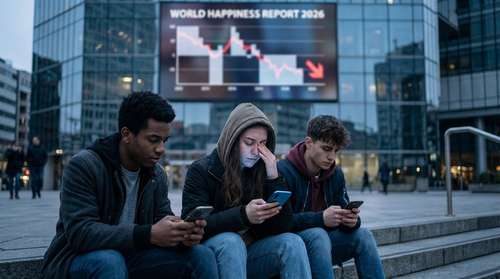
The global landscape of youth well-being has officially fractured. Released last Thursday, March 19, the World Happiness Report 2026 delivers a sobering verdict: a severe youth mental health crisis is sweeping across English-speaking nations and Western Europe. For the first time in the publication's 14-year history, researchers have explicitly linked steep declines in adolescent life satisfaction to the algorithmic nature of modern digital environments, compounding the weight of mounting economic pressures.
Synthesizing responses from approximately 100,000 individuals across 140 countries, the Oxford Wellbeing Research Centre, alongside Gallup and the UN, uncovered a staggering reality. Life evaluations among people under 25 in the United States, Canada, Australia, and New Zealand have plummeted by nearly a full point on a 10-point scale over the past two decades. This sharp divergence between younger and older populations highlights an urgent need to reevaluate how teenagers interact with technology and navigate an increasingly uncertain financial future.
The Algorithm Effect: Social Media and Mental Health
The 2026 data draws a definitive line between platform architecture and psychological well-being. According to the expansive study, the relationship between social media and mental health is no longer just a correlation; it is a primary driver of psychological distress for adolescents.
However, not all screen time is created equal. The researchers highlight that visual, algorithm-driven platforms designed for endless scrolling—such as Instagram and TikTok—inflict significantly more damage than communication-focused apps like WhatsApp or standard texting. These algorithmic feeds trap users in continuous cycles of social comparison, leading to profound digital burnout symptoms such as chronic fatigue, attention fragmentation, and emotional exhaustion.
Data from global PISA studies included in the report reveals that teens logging seven or more hours daily on social networks report vastly lower life satisfaction than those averaging under an hour. Teenage girls in Western markets appear uniquely vulnerable to these specific platform mechanics, exhibiting the sharpest drop in overall happiness. Interestingly, the data indicates that moderate usage—defined as under 60 minutes a day—actually correlates with slightly better well-being than complete digital isolation, suggesting that total prohibition may strip teens of essential peer connectivity.
Gen Z Anxiety Trends Fueled by Economic Stress
While smartphones provide the vehicle for social comparison, broader macroeconomic factors are supplying the underlying fuel. Beyond the glowing screens, Gen Z anxiety trends are heavily influenced by tangible, real-world instability.
Jan-Emmanuel De Neve, director of the Wellbeing Research Centre, pointed out that youth in the US and UK frequently cite housing affordability and the uncertain future of work as primary sources of daily distress. The fear of traditional career paths vanishing and the stark reality of inflation create a pervasive backdrop of economic stress. When financial insecurity merges with the hyper-curated, often unrealistic lifestyles broadcasted by online influencers, it creates a toxic environment where clinical anxiety can easily thrive.
Young adults are essentially fighting a two-front war: managing the engineered addiction of digital platforms while trying to establish financial independence in an unforgiving global economy.
Global Happiness Rankings 2026 Highlight the Divide
The geographic disparities in this year's data are striking. The global happiness rankings 2026 mark the second consecutive year that zero English-speaking countries broke into the top 10. The US slid to 23rd place, while the UK dropped to 29th.
Conversely, nations prioritizing community infrastructure and robust social safety nets continue to dominate. Finland secured the title of the world's happiest country for an unprecedented ninth year. Notably, Costa Rica surged into fourth place—the highest ever for a Latin American nation—largely due to strong community involvement and tight-knit family bonds that act as a buffer against digital isolation. In countries like Lithuania, youth well-being remains exceptionally high despite widespread internet access, proving that robust cultural context and real-world integration matter immensely.
Forging Mental Health Solutions for Teens
Addressing this generational tipping point requires moving past simple screen-time bans and individual blame. Effective mental health solutions for teens must tackle both the technological architecture and the social fabric surrounding young people.
Here are the actionable shifts supported by the latest international research:
- Algorithmic distance: Encourage a shift away from infinite-scroll visual feeds toward closed-network messaging apps that prioritize genuine interpersonal connection rather than performative broadcasting.
- Community anchoring: The success of nations like Costa Rica underscores the vital importance of offline, community-based activities to offset the isolating effects of digital environments.
- Usage moderation over prohibition: Limiting daily social media intake to roughly one hour yields the highest well-being scores, fostering peer connection without triggering comparison fatigue.
- Policy intervention: Governments are increasingly utilizing this data to discuss age-based access restrictions and algorithmic regulations to protect developing minds from aggressive engagement tactics.
The World Happiness Report 2026 serves as a definitive warning. By understanding the specific mechanics of digital burnout and acknowledging the valid economic anxieties facing young adults, policymakers, educators, and parents like you can begin to bridge the widening happiness gap before it becomes a permanent generational scar.