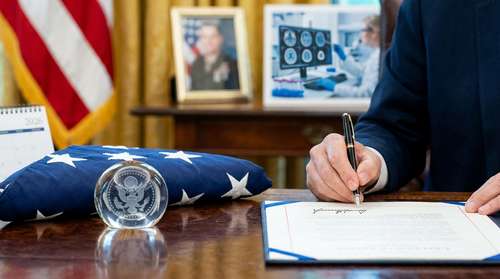
On Saturday, April 18, 2026, President Donald Trump signed a landmark directive aimed at overhauling how the federal government handles alternative treatments for severe psychological conditions. Framed as a critical response to the nation's ongoing mental health and veteran suicide crises, the highly anticipated executive order on psychedelics 2026 directs federal agencies to aggressively accelerate the review and potential approval of schedule I substances, including psilocybin, MDMA, and the plant derivative, ibogaine.
Flanked in the Oval Office by Health Secretary Robert F. Kennedy Jr., FDA Commissioner Marty Makary, conservative podcaster Joe Rogan, and former Navy SEAL Marcus Luttrell, Trump declared the current federal prohibition of these medicines effectively outdated. By cutting bureaucratic red tape, the administration hopes to bring historically sidelined treatments into clinical reality, offering fresh hope to millions of Americans suffering from treatment-resistant depression, post-traumatic stress disorder (PTSD), and traumatic brain injuries.
A Historic Shift: The Executive Order on Psychedelics 2026
For decades, drugs that act as serotonin agonist receptors have been strictly locked behind Schedule I classifications, rendering scientific exploration nearly impossible. The newly signed Trump psychedelic research order turns this paradigm on its head. Instead of defaulting to restriction, the White House is now actively pressuring the Food and Drug Administration (FDA) and the Drug Enforcement Administration (DEA) to prioritize medical innovation.
Under this new mandate, FDA Commissioner Marty Makary announced that the agency will issue Commissioner's National Priority Vouchers to experimental drugs that have already shown clinical promise. This pivotal move will essentially slash federal review timelines from several months to a matter of weeks. The administration's willingness to see the FDA fast track psilocybin and other breakthrough therapies signifies a monumental pivot away from the restrictive drug policies of previous decades.
Expanding Right To Try Mental Health Drugs
One of the most immediate impacts of the executive order is its expansion of existing legislation. Trump has directed regulators to establish a clear pathway for eligible patients to access investigational compounds before full market approval. By leveraging the framework of the Right To Try mental health drugs initiative, terminally or severely ill patients—particularly combat veterans who have exhausted conventional psychiatric medications—will be legally permitted to seek out psychedelic assisted therapy under medical supervision.
Federal Dollars for State-Level Innovation
Beyond policy adjustments, the directive comes with significant financial backing. The order directs the Department of Health and Human Services to provide $50 million in match-funding for states already investing in psychedelic studies. This is a direct nod to states like Texas, which recently carved out $50 million to establish a research consortium for clinical trials but struggled to finalize funding avenues independently.
The Rise of Ibogaine for PTSD Treatment
Perhaps the most unexpected inclusion in the president's mandate is ibogaine. Originating from a shrub used historically in Gabon, ibogaine has long been viewed with extreme skepticism by federal scientists. In the 1990s, the National Institutes of Health (NIH) discontinued research into the substance due to concerns over cardiovascular toxicity, specifically its potential to trigger dangerous heart conditions.
Despite the risks, the push to utilize ibogaine for PTSD treatment and opioid addiction has gained massive traction among special operations veterans. Recent data from a small Stanford University study—which tracked 30 veterans who traveled to clinics in Mexico—demonstrated profound improvements in cognitive functioning and reductions in anxiety, depression, and PTSD symptoms. With emergency medical equipment and careful cardiac monitoring, advocates argue the clinical risks can be safely managed. Thanks to the new executive action, the FDA is now clearing the way for the first-ever sanctioned human trials of ibogaine within U.S. borders.
Setting the Stage for Mental Health Breakthroughs 2026
The ripple effects of this policy shift will likely redefine psychiatric care in the United States. While no psychedelic has been formally approved for public commercial sale yet, the pipeline is moving at unprecedented speeds. With clinical trials expanding rapidly and federal roadblocks dissolving, researchers anticipate that mental health breakthroughs 2026 will set the foundation for an entirely new era of behavioral medicine.
Critics caution that moving too quickly could bypass rigorous safety protocols, especially considering the intense psychological vulnerability inherent in hallucinogenic experiences. However, for the veterans and patient advocates who stood in the Oval Office this weekend, the urgency is entirely justified. When standard medications and traditional therapies fail, patients are left with few lifelines. By forcing federal health agencies to embrace rather than punish scientific curiosity, the administration is betting that the profound benefits of these compounds will heavily outweigh the bureaucratic risks.