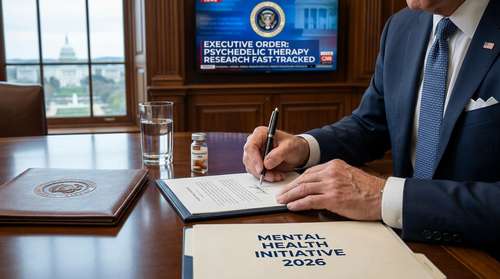
In what marks a monumental shift in federal drug policy, President Donald Trump signed a landmark psychedelic therapy executive order on Saturday, April 18, 2026, directing federal agencies to fast-track research and access to substances like psilocybin, MDMA, and ibogaine. Flanked in the Oval Office by Health and Human Services (HHS) Secretary Robert F. Kennedy Jr., podcaster Joe Rogan, and former Navy SEAL Marcus Luttrell, the President outlined a sweeping directive aimed at providing immediate relief for the 14 million Americans battling severe mental illness. For those tracking mental health news today, this unprecedented move represents the most significant federal pivot toward embracing mind-altering compounds for therapeutic use in U.S. history.
A New Era for Mental Health: The Psychedelic Therapy Executive Order
The core of Saturday's directive focuses on eliminating bureaucratic red tape that has long bottlenecked psychedelic science. Under the new mandate, the Food and Drug Administration (FDA) is instructed to issue expedited guidance for researchers designing clinical trials. This aggressive timeline aims to integrate these substances into safe, clinical environments, positioning them as viable treatment resistant depression solutions for patients who have exhausted traditional pharmaceuticals.
"In many cases, these experimental treatments have shown life-changing potential for those suffering from severe mental illness and depression—including our cherished veterans," Trump stated during the signing ceremony. The order mandates improved data sharing between the FDA and the Department of Veterans Affairs (VA) to ensure fast rescheduling of any psychedelic drugs that secure FDA approval.
Advancing Psilocybin for PTSD Research
Federal health regulators have previously granted "breakthrough therapy" status to certain compounds like psilocybin and MDMA, acknowledging their potential to offer substantial improvements over existing medications. By prioritizing psilocybin for PTSD research, the administration hopes to unlock new therapeutic mechanisms that address the root causes of trauma rather than merely masking daily symptoms. Historically, researchers attempting to study Schedule I substances face a labyrinth of DEA approvals, security requirements, and funding restrictions. The new directive forces the FDA to publish streamlined guidance specifically tailored for serotonin receptor agonists, enabling scientists to initiate studies faster and with greater federal support.
Funding Ibogaine Clinical Trials 2026
Perhaps the most surprising element of the announcement is the federal government's $50 million commitment to support state-level research on ibogaine. A powerful psychoactive alkaloid derived from a West African shrub, ibogaine has gained significant traction for its reported ability to interrupt severe opioid addiction and treat traumatic brain injuries (TBI). The executive order opens a distinct pathway for ibogaine clinical trials 2026 and allows the substance to be administered to severely ill patients under the federal Right to Try law.
However, the move is not without its detractors. Critics, including former White House drug policy adviser Kevin Sabet, warn that ibogaine carries documented cardiovascular risks. Sabet argued that the administration's push might encourage hasty and potentially dangerous research, signaling a vital need for rigorous safety protocols as the trials expand into commercial medical spaces.
RFK Jr Health Policy and Bipartisan Momentum
This rapid acceleration of psychedelic medicine is a cornerstone of the developing RFK Jr health policy. Secretary Kennedy has been highly vocal about his ambition to integrate psychedelic therapeutics into the mainstream healthcare system, previously stating a goal of achieving medical approvals within 12 months. Podcaster Joe Rogan, who has frequently used his massive platform to advocate for the medicinal use of psychedelics, reportedly texted the President information regarding ibogaine's efficacy prior to the signing. According to those present, this direct communication helped catalyze the final details of the order.
The initiative has also catalyzed rare bipartisan alignment. Conservative lawmakers and red states, including Texas and Arizona, have aggressively pursued state-level funding for psychedelic research, recognizing the urgent need to address the compounding mental health crisis. This decentralized momentum is now being matched by federal backing.
Targeting Veteran Suicide Prevention 2026
The presence of combat veterans like Luttrell at the Oval Office signing highlights the administration's primary motivation: veteran suicide prevention 2026. With traditional psychiatric interventions often failing those returning from combat zones, veterans advocacy groups have increasingly turned to underground or international clinics in countries like Mexico to access ibogaine and psilocybin therapies.
By bringing these treatments into regulated, federally funded clinical settings, the government aims to stem the tragic tide of veteran suicides linked to treatment-resistant PTSD and TBI. The directive ensures that those who served will be at the forefront of the upcoming clinical trials, potentially transforming the landscape of mental healthcare and offering a lifeline to millions who have previously run out of options.