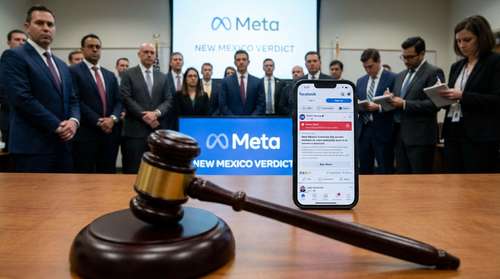
In a devastating legal blow to Big Tech, a landmark ruling has just redefined corporate responsibility in the digital age. On March 24, 2026, a Santa Fe jury officially found Meta liable for violating state consumer protection laws, concluding that the tech giant knowingly deceived the public and endangered its youngest users. The outcome of this pivotal Meta lawsuit children's mental health trial marks the first time a major social networking conglomerate has faced a monetary jury verdict over the psychological and physical harms caused by its fundamental product design.
The jury's swift decision, ordering a staggering $375 million in civil penalties, concluded a nearly seven-week trial that captivated the nation. State prosecutors successfully argued that the parent company of Facebook and WhatsApp prioritized user engagement and advertising revenue over essential child safety protocols, deliberately ignoring internal data about platform toxicity.
Unpacking the Historic New Mexico Meta Verdict
The foundation of the state's monumental victory lies in New Mexico's Unfair Practices Act. New Mexico Attorney General Raúl Torrez, who initiated the lawsuit in December 2023, built a compelling case demonstrating that Meta executives ignored explicit internal warnings about the severe dangers lurking on their platforms.
Jurors determined that the company committed thousands of separate violations, imposing the maximum statutory penalty of $5,000 for each individual offense. According to Torrez, this $375 million judgment is a historic victory for families who have suffered due to algorithmic negligence, sending a clear message that no corporation is beyond the reach of the law.
During the proceedings, the court reviewed a mountain of disturbing evidence. A critical component was a state-run undercover investigation where law enforcement agents created accounts posing as young teenagers. These decoy profiles were rapidly targeted by sexual predators, exposing massive blind spots in Meta's moderation systems and a severe lack of age-appropriate safeguards.
The Instagram Impact on Youth Health and Alleged Deception
At the core of the trial was the profound Instagram impact on youth health. Witnesses, ranging from psychiatric experts to local school educators, detailed how addictive platform features directly correlate with sleep deprivation, severe anxiety, self-harm, and eating disorders among teenagers. The jury even heard harrowing accounts of sextortion schemes that originated within the company's messaging ecosystems.
Prosecutors maintained that Meta deployed deceptive marketing strategies to convince parents that their digital environment was secure. The jury ultimately agreed, finding that the tech conglomerate engaged in unconscionable trade practices that unfairly exploited the vulnerability and inexperience of adolescents.
Corporate Response and Meta Legal News 2026
In response to the judgment, a Meta spokesperson confirmed the company's intention to appeal the decision. Defense attorneys argued throughout the trial that they invest heavily in content moderation and age verification, stating they want users to feel good about the time spent online. Despite the massive penalty, the financial blow represents a tiny fraction of Meta's $201 billion revenue from 2025, and the company's stock notably rose 5% in after-hours trading following the announcement. For those tracking Meta legal news 2026, this appeal process will likely stretch out for years, establishing critical new case law.
The First Domino in the Social Media Addiction Lawsuit Wave
New Mexico's triumph does not exist in a vacuum. It is widely considered the opening salvo in a much larger judicial reckoning concerning tech giants mental health liability.
Currently, jurors in a Los Angeles federal court are sequestered in a similar, massive social media addiction lawsuit against both Meta and Google's YouTube. While competitors like Snap and TikTok have reached settlements in related cases, Meta has chosen to battle these allegations in court. Over 40 other state attorneys general have filed coordinated litigation against Mark Zuckerberg's empire, arguing that the deliberate gamification of feeds constitutes a nationwide crisis.
Historically, tech platforms have shielded themselves behind Section 230 of the Communications Decency Act, claiming immunity from third-party content. However, this verdict succeeded because prosecutors successfully targeted the fundamental product design, defective algorithms, and deceptive corporate communications, bypassing traditional free speech defenses.
Shaping the Future of Social Media Safety for Kids
While the immediate monetary penalty makes global headlines, the long-term implications of this trial will likely reshape digital infrastructure forever. The next phase of the New Mexico proceeding rests with State District Judge Bryan Biedscheid, who will rule on the broader public nuisance allegations.
If the judge rules against the corporation in this subsequent phase, Meta could be legally forced to fund statewide public programs dedicated to repairing the psychological damage inflicted on the youth population. Furthermore, Torrez's office is seeking court-mandated structural changes to the platforms to ensure robust social media safety for kids moving forward, such as stricter age verification protocols.
For parents, educators, and youth mental health advocates, this week's ruling validates years of desperate warnings. The era of unchecked algorithmic experimentation on children may finally be drawing to a close, forcefully replaced by an uncompromising standard of legal accountability.