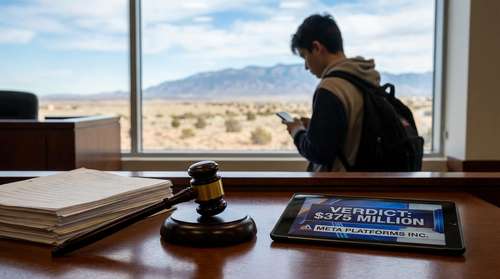
A historic legal battle culminated on Tuesday, March 24, 2026, when a Santa Fe jury delivered a massive blow to one of the world's largest technology conglomerates. In a watershed moment for the ongoing Meta youth mental health lawsuit, jurors found that the parent company of Facebook and Instagram deliberately concealed the dangers its platforms pose to children. The landmark New Mexico Meta verdict 2026 imposes a staggering Meta 375 million dollar penalty after a grueling six-week trial. By ruling that the tech giant knowingly prioritized algorithmic engagement over adolescent safety, this decision officially signals a new era for Big Tech mental health accountability, proving that consumer protection laws can successfully rein in digital titans.
Unpacking the Groundbreaking New Mexico Meta Verdict 2026
Following just hours of deliberation, the New Mexico jury sided overwhelmingly with state prosecutors, determining that Meta violated the state's Unfair Practices Act. The state successfully argued that the company engaged in unconscionable and deceptive trade practices by publicly marketing its platforms as safe while internally acknowledging severe risks to young users.
Jurors identified tens of thousands of individual violations, deciding that each impacted teenager represented a distinct breach of the law. By applying the maximum $5,000 fine per violation, the jury reached the staggering $375 million judgment. The lawsuit, spearheaded by New Mexico Attorney General Raúl Torrez in 2023, represents a massive victory for child safety advocates across the country.
Torrez declared the verdict a historic win for families who have paid the price for corporate greed, establishing that no Silicon Valley entity is immune to state consumer protection laws. During closing arguments, state attorneys emphasized that Meta had spent a decade failing to act transparently, ultimately leaving the jury with the responsibility to hold the corporation liable for its deliberate inaction.
Navigating the Social Media Impact on Adolescent Mental Health
Central to the state's case was the profound social media impact on adolescent mental health. Prosecutors presented compelling evidence that Meta engineered its applications to maximize user retention, fully aware that such design choices exacerbate teen anxiety and social media addiction. The trial prominently featured a recorded deposition from Meta CEO Mark Zuckerberg, highlighting the stark contrast between internal corporate knowledge and external safety claims.
During the proceedings, the jury heard how the Instagram mental health effects on teens extend far beyond simple screen time or peer comparison. Internal company documents and a chilling 2023 state undercover investigation revealed severe vulnerabilities built directly into the user experience. Investigators posing as minors were quickly targeted by explicit content and predatory behavior shortly after creating their profiles.
Exposing Deceptive Safety Practices
The state effectively demonstrated that Meta lacked basic, functional safeguards like robust age verification. This negligence created a digital environment where predators could easily trade illicit material and solicit minors. Despite executives knowing about these rampant, systemic issues, the corporation continued to publicly boast about its rigorous safety protocols, effectively lulling parents into a false sense of security regarding their children's online activities.
A Watershed Moment for Big Tech Mental Health Accountability
This ruling in Santa Fe is not an isolated incident; it serves as a critical bellwether for a tidal wave of litigation currently sweeping the United States. New Mexico's case was the first of its kind to reach a jury, but it certainly will not be the last. More than 40 state attorneys general have filed similar actions against Meta, arguing that the corporation is actively fueling a nationwide youth mental health crisis through deliberately addictive product design.
While the financial penalty is substantial, Wall Street's immediate reaction was surprisingly muted. Meta, currently valued at roughly $1.5 trillion, actually saw its stock rise by 5% in after-hours trading shortly following the announcement, suggesting shareholders largely shrugged off the fine as a minor operational expense. However, the legal precedent established by this trial poses a far greater existential threat to the company's core business model than the immediate monetary loss.
In Los Angeles, another jury just finished deliberations on a related landmark case involving both Meta and YouTube, further compounding the pressure on tech executives. The legal landscape is rapidly shifting, transitioning from abstract legislative debates to concrete courtroom defeats that mandate genuine accountability.
Looking Ahead After the Meta 375 Million Dollar Penalty
Unsurprisingly, Meta quickly released a statement disagreeing with the jury's findings and confirming its plans to appeal the decision. Company representatives continue to argue that they deploy extensive resources to identify and remove harmful content, claiming the platforms are overwhelmingly safe for teenage users and pointing to the inherent difficulties of policing billions of daily interactions.
However, the legal battle in New Mexico is far from over. A critical second phase of the trial is officially scheduled for May 2026. During this upcoming session, Attorney General Torrez will petition the court to mandate sweeping, structural changes to Meta's platforms to actively protect minors. If successful, this injunction could force the implementation of aggressive age verification systems, mandatory parental controls, and algorithmic adjustments designed directly to curb the platform's addictive nature.
As the public demands a safer digital landscape for the next generation, this monumental verdict proves that communities are no longer willing to accept the collateral damage of a highly profitable, unregulated social ecosystem. The days of tech giants operating without oversight are rapidly coming to an end, paving the way for a more responsible internet.