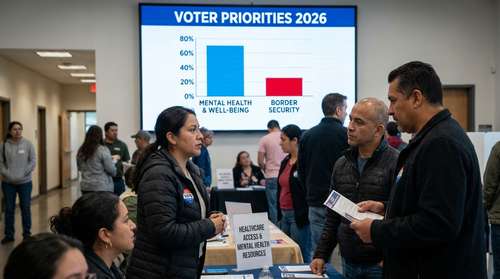
A profound shift is transforming the political landscape this year as emotional well-being takes center stage at the ballot box. A landmark University of Missouri mental health study released on March 18, 2026, reveals that voters are now placing psychological wellness above traditionally dominant campaign flashpoints. In fact, robust mental health policy 2026 platforms are proving more critical to electoral success than aggressive stances on border security, proposed TikTok bans, or billionaire taxes. The findings indicate that the political playbook is undergoing a massive rewrite, with candidates' plans for care access emerging as a decisive factor for a deeply stressed electorate.
The Surprising Shift in U.S. Voter Priorities 2026
When political analysts chart the defining issues of an election cycle, they typically look toward the economy, foreign policy, and immigration. However, the latest research published in the peer-reviewed journal PLOS One challenges these established narratives. Led by Jake Haselswerdt, an associate professor of political science at Mizzou’s College of Arts and Science, the study benchmarks the true impact of emotional and psychological well-being on voter behavior.
Researchers utilized a high-quality, nationally representative sample of 1,000 American adults from the Cooperative Election Study. By pitting various high-profile policy stances against each other through experimental simulation, the survey forced respondents to reveal what genuinely drives their choices. The results were clear: the landscape of U.S. voter priorities 2026 has fundamentally evolved. Rather than merely offering verbal support for wellness initiatives, citizens are actively using their ballots to demand legislative action. When forced to choose, a candidate's position on expanding psychological support systems frequently eclipsed highly polarized topics like border control and carbon emission regulations.
How Healthcare Access Voting Tips the Electoral Scales
Understanding the role of mental health in elections requires looking past broad approval ratings. For years, polls have shown that Americans generally favor better psychiatric and therapeutic care. What this new data illustrates is that this support has sharp political teeth. Even minor policy variations regarding psychological care demonstrated a remarkable ability to sway a voter's preference toward a specific candidate.
This dynamic of healthcare access voting acts as a powerful electoral tiebreaker. Haselswerdt noted his initial hypothesis assumed topics generating the most media coverage would easily dominate voter preferences, but the empirical data proved otherwise. Care access was consistently the issue that tipped the scales in a candidate's favor. While the research identified that liberals, individuals with higher incomes, and those currently experiencing poor health are particularly motivated by these platforms, the demand for better care crosses traditional demographic boundaries. Voters are signaling that they view a candidate’s empathy and actionable health plans as a direct reflection of their fitness for public office.
The Disconnect Between Media and Main Street
One of the most striking takeaways from the University of Missouri investigation is the glaring disconnect between what the media portrays as vital and what the public actually values. Turn on any cable news network, and the discourse is almost exclusively saturated with border wall debates, social media regulation, and taxation battles. Yet, quietly and decisively, the electorate is moving beyond these binary arguments, favoring a more humanistic approach to governance.
Addressing the American Mental Health Crisis
The sudden elevation of this issue does not exist in a vacuum. It is a direct, urgent response to the escalating American mental health crisis that touches nearly every community across the country. Recent polling from the National Alliance on Mental Illness highlights that one in six adults currently reports experiencing poor mental health. Families are buckling under the combined weight of the high cost of living, daily stressors, and a fractured medical infrastructure that makes getting help both difficult and prohibitively expensive.
For everyday citizens, the intersection of mental health and public policy is no longer an abstract concept debated in distant committee rooms. People are evaluating local and national candidates based on whether they support concrete solutions—such as the Better Health Care for Americans Act—which aim to bridge the glaring gaps in treatment availability. They are looking for leaders who understand that national security means little if the domestic population is internally struggling and unable to access basic psychological interventions.
What This Means for Politicians and Policymakers
Politicians who continue to rely solely on legacy talking points risk alienating a massive block of active voters. The findings from this 2026 study serve as a loud wake-up call for campaign managers and elected officials mapping out their strategies for the remainder of the election cycle. The data confirms that integrating comprehensive wellness strategies into legislative agendas, budgeting priorities, and public health planning is no longer just a moral imperative—it is a proven political advantage.
By stepping away from manufactured outrage and focusing on the humanistic dimensions of government, leaders can connect with voters on a profoundly personal level. The electorate is exhausted by partisan gridlock and desperate for tangible health solutions. For any candidate hoping to secure a victory this year, championing mental well-being is no longer optional; it is the winning ticket for the future of American politics.