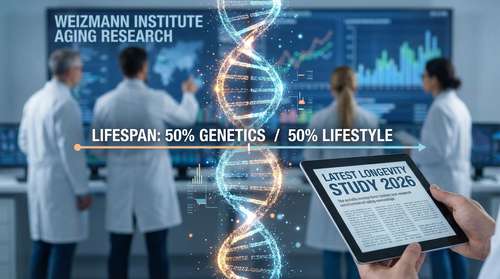
For decades, health experts have championed the idea that diet, exercise, and daily habits are the absolute architects of your life expectancy. But a sweeping longevity genetics study 2026 has just completely upended the traditional scientific consensus. Detailed in fresh analytical data released over the weekend—following a foundational publication in the journal Science—researchers have revealed that your DNA is far more influential than anyone previously estimated. In fact, experts now confirm that genetics control approximately 50% of human lifespan variation.
This paradigm-shifting discovery forces the medical community to reevaluate the balance between biological destiny and daily choices. If you have ever wondered why some individuals live past 100 despite less-than-ideal habits, the answer is heavily written in their cellular code.
The Breaking Longevity Genetics Study 2026
The core of this revelation stems from highly sophisticated Weizmann Institute aging research led by physicist Ben Shenhar and systems biologist Prof. Uri Alon. Historically, scientists believed the genetic influence on lifespan was relatively minor, with older calculations placing heritability somewhere between 20% and 25%, and some datasets placing it below 10%. The Israeli research team suspected those numbers were fundamentally skewed by historical noise.
To find the truth, they turned to comprehensive historical databases, analyzing hundreds of thousands of twin records from Sweden and Denmark. Crucially, their dataset included identical twins who were raised in entirely different households. Because identical twins share the exact same genetic blueprint but not the same environment, they provide the ultimate testing ground for untangling nature from nurture.
Correcting the Historical Record
The researchers utilized advanced mathematical modeling to filter out what scientists call extrinsic mortality—deaths caused by external forces such as accidents, homicides, or severe infectious diseases. In previous centuries, these unpredictable external events claimed countless lives prematurely, masking the true biological limits of the human body. Once the Weizmann team stripped away these external variables, the deep-seated signal of intrinsic biological aging emerged clearly. The resulting data from this longevity genetics study 2026 proved that a staggering 50% to 55% of longevity is directly tied to heritable genetic factors.
According to the researchers, finding a 50% heritability rate for lifespan shouldn't be entirely shocking. When analyzing twin data for almost any major complex physiological trait—such as height, muscle composition, or the age of onset for menopause—the genetic influence consistently hovers around that 50% mark. Longevity was always an unexplained outlier in historical data, but thanks to better analytical models, it now aligns perfectly with the rest of human biology.
Biological Aging vs Lifestyle: The New Reality
Does this breakthrough mean you should abandon your gym membership and Mediterranean diet? Absolutely not. The ongoing debate surrounding biological aging vs lifestyle is simply becoming more nuanced. The remaining 50% of your lifespan variation is still heavily influenced by environmental conditions, random biological chance, and how well you take care of your body.
However, understanding the heavy weight of the DNA and healthy aging connection fundamentally changes our approach to wellness. Lifestyle interventions may help you reach the absolute maximum potential of your genetic ceiling, but that ceiling is ultimately constructed by your inherited biology.
Decoding the Secrets of Centenarians
This updated perspective perfectly explains the phenomenon of centenarians. People who celebrate their 100th birthdays are not simply clawing their way to a century through sheer willpower or impeccable diets. They are essentially wearing genetic body armor. Specific inherited traits actively protect them against the chronic, age-related diseases that typically shorten human life.
Building a Genetic Profile
While a few standout genes like FOXO3, APOE, and SIRT6 have already been linked to exceptional longevity, researchers stress that no single fountain of youth gene exists. Instead, a massive, complex network of genetic variants works in tandem to regulate cellular repair, manage inflammation, and maintain metabolic health over decades.
The Reality of Predicting Lifespan Genetics
The implications for modern medicine are staggering. The science of predicting lifespan genetics is rapidly evolving from a theoretical concept into a practical clinical tool. As sequencing technology becomes faster and more affordable, doctors will soon be able to evaluate a patient's inherited longevity profile.
Critics of early lifespan research often pointed to infectious diseases as proof that environment trumps genetics. But even then, modern immunology shows that your DNA dictates how aggressively your immune system responds to foreign pathogens. Every layer of human survival is intricately woven with genetic code. Armed with this genetic foresight, medical professionals could implement highly targeted preventative care long before age-related diseases take root.
Driving Healthy Aging Breakthroughs 2026
This landmark longevity genetics study 2026 completely resets the stage for biotechnology and pharmaceutical development. By confirming that aging itself has such a massive genetic foundation, scientists have a much stronger mandate to pursue genetic research into aging. Rather than playing a reactive game with individual age-related diseases like Alzheimer's or heart disease, the next generation of treatments will target the underlying genetic mechanisms of cellular decay.
The revelations pouring out of the Weizmann Institute represent just the beginning of the healthy aging breakthroughs 2026 is slated to deliver. While we cannot rewrite the DNA we inherited at birth, unlocking exactly how it dictates our physical decline gives us the best possible blueprint for extending human healthspan.