For families navigating the turbulent realities of adolescent mental health, finding effective clinical interventions often feels like fighting an uphill battle. But a groundbreaking clinical pilot study released on April 9, 2026, is offering renewed hope for pediatric psychiatry. Researchers have demonstrated that Deep Intracranial Frequency Stimulation (DIFS) can significantly reduce symptoms of treatment-resistant depression in teens, as well as halt non-suicidal self-injurious behaviors. This neurotechnology represents a profound leap forward, showcasing how targeted brain stimulation might soon replace or supplement traditional pharmacology.
The urgency for a reliable teen self-harm prevention strategy has never been greater. While traditional antidepressants and cognitive therapies are effective for many, they frequently leave a critical gap for adolescents battling severe, unrelenting symptoms. This newly published peer-reviewed study in BMC Psychiatry highlights an accelerating shift toward non-drug depression therapy. By utilizing an advanced neuromodulation device developed by Nexalin Technology, investigators were able to provide rapid, measurable relief to a highly vulnerable patient demographic.
How High-Power Neurotechnology for Mental Health Works
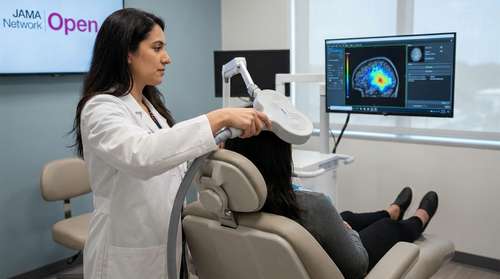
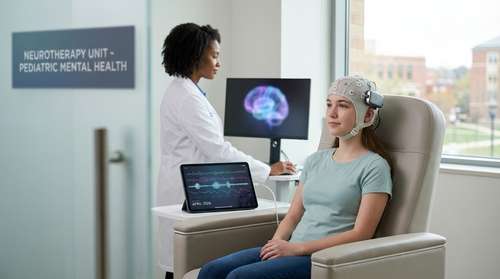
Unlike invasive surgical procedures or systemic medications that can cause widespread side effects, the Nexalin DIFS platform is entirely non-invasive. The therapy utilizes a 77.5 Hz high-gamma transcranial alternating current stimulation (tACS) approach, delivered at 15 milliamps. This specific, high-power waveform allows the electrical pulses to penetrate deeply into the midbrain structures that govern mood, anxiety, and stress responses.
For decades, surface-level brain stimulation struggled to reach these deeper neurological hubs reliably without significant signal degradation. The 15 mAmp DIFS technology overcomes that barrier, targeting the precise dysfunctional brain activity associated with severe psychiatric disorders. In terms of safety, the protocol appears remarkably well-tolerated among young patients. During the clinical evaluation, no significant adverse effects were observed. Only one participant reported a mild, transient headache that resolved quickly, positioning this hardware as one of the most promising pediatric mental health breakthroughs of the year.
The Challenge of Halting Treatment-Resistant Depression in Teens
Non-suicidal self-injury (NSSI) is notoriously difficult to treat. It often functions as an unhealthy coping mechanism for profound emotional pain, anxiety, and cognitive rumination. When standard SSRI medications fail to regulate these intense emotions, patients are often classified as having treatment-resistant depression in teens.
The recent clinical trial tackled this specific demographic by tracking six female adolescent patients, all of whom had a documented history of NSSI and persistent depressive symptoms. Each participant underwent a comprehensive 21-day regimen of daily 77.5 Hz stimulation. The resulting data, captured through validated psychiatric frameworks like the HAMD-24 depression scale and the Ottawa Self-Injury Inventory (OSIC), revealed dramatic, rapid symptom reductions.
At the follow-up assessments, an extraordinary 100% of the adolescents met the study's predefined clinical response criterion for depression recovery. Even more critically, 83.3%—five out of the six patients—successfully met the response threshold for ceasing self-injury thoughts and behaviors entirely. Secondary clinical measures also indicated substantial improvements in overall anxiety levels and nighttime sleep quality, reinforcing the therapy's holistic benefits.
Mapping Objective Brain Connectivity Changes
Psychiatric studies frequently rely exclusively on patient-reported symptom surveys, which can introduce subjectivity. To establish concrete physiological evidence, the research team employed TMS-EEG (transcranial magnetic stimulation combined with electroencephalography) to map the patients' brains before and after the 21-day protocol.
The resulting neuroimaging revealed clear structural and functional connectivity changes across major emotional-control networks. Specifically, researchers documented measurable alterations in the Default Mode, Limbic, Salience/Ventral Attention, and Executive Control networks. These interconnected brain circuits are heavily implicated in emotional dysregulation and the looping, ruminative thoughts that often precede an act of self-harm. By effectively rewiring these specific circuits, the high-gamma stimulation didn't just mask the patients' symptoms—it fundamentally corrected the underlying network miscommunications driving their severe distress.
Setting the Standard for Adolescent Depression Treatments 2026
While the initial cohort size is small and lacked a sham-control group, the dual confirmation of clinical symptom relief alongside objective electrophysiological changes provides powerful validation for the DIFS mechanism. Nexalin Technology executives, including Chief Medical Officer Dr. David Owens, noted the significance of targeting the exact brain networks responsible for emotional regulation, while study investigators emphasized that these findings justify moving rapidly into larger, randomized controlled trials.
For the broader medical community, the peer-reviewed data presents a compelling argument for expanding deep brain neuromodulation research. Reaching adolescents who have failed standard therapies requires innovative, forward-thinking medical engineering. As clinical science continues to map the exact electrical frequencies and currents needed to heal the traumatized brain, non-invasive deep intracranial therapies are poised to redefine exactly what is possible in youth psychiatric care over the coming decade.